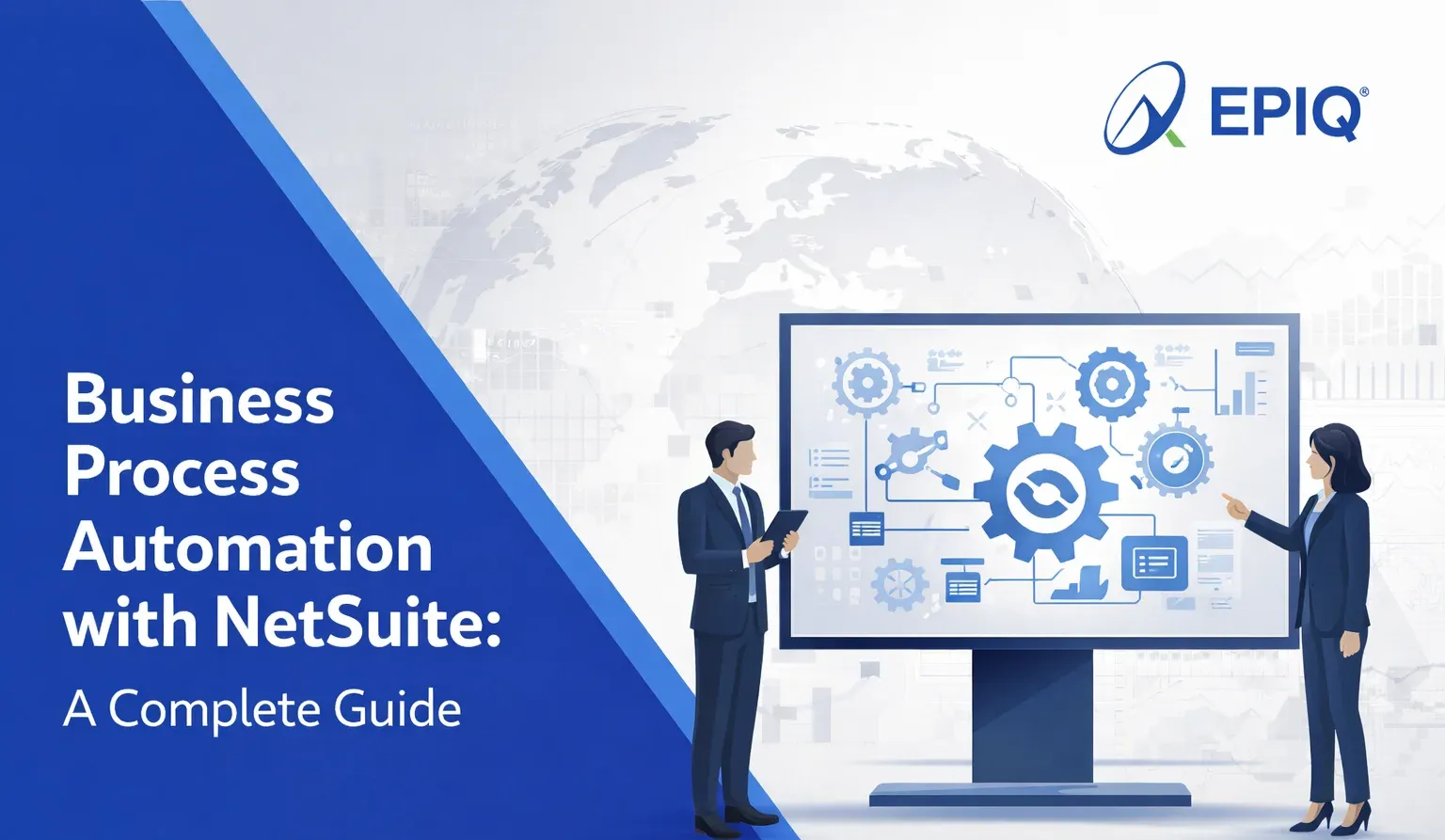
In today’s fast-paced business environment, manual processes are no longer sustainable. Companies that fail to embrace automation risk falling behind competitors who leverage technology to work smarter and operate more efficiently. Business Process Automation (BPA) with NetSuite offers a powerful solution for organizations seeking to eliminate redundancies, reduce errors, and unlock new levels of operational efficiency.
This comprehensive guide explores how NetSuite ERP automation can transform your business operations, the key processes you should automate, and the tangible benefits you can expect from implementation.
What is Business Process Automation with NetSuite?
Business Process Automation refers to the use of technology to automate recurring tasks or processes in a business, replacing manual effort. These processes can range from simple data entry to complex multi-step workflows involving multiple departments and systems.
NetSuite, a leading cloud-based ERP platform, provides robust automation capabilities that integrate seamlessly across all business functions — from finance and inventory to CRM and e-commerce. Unlike standalone tools, NetSuite business automation works within a unified system, ensuring data consistency and real-time visibility across your organization.
Industry Insight
According to industry research, businesses that implement comprehensive automation strategies can reduce operational costs by up to 30% while improving processing speed by 50-70%.
Key Business Processes to Automate with NetSuite
Order-to-Cash Process
NetSuite can automate order entry, credit checks, inventory allocation, fulfillment routing, invoice generation, and payment processing. From order placement to payment collection, the entire cycle can run without manual intervention.
Optimization Impact
Companies typically see a 40-60% reduction in order processing time and a 25% decrease in order errors through automated order management.
Inventory Management and Planning
Automation includes real-time stock monitoring, demand forecasting, automated purchase orders, and intelligent stock transfers across locations.
Optimization Impact
Businesses often achieve a 20-30% reduction in carrying costs and a 15-25% improvement in inventory turnover rates.
Financial Close and Reporting
NetSuite automates journal entries, inter-company eliminations, reconciliations, and financial reporting workflows, dramatically reducing manual consolidation work.
Optimization Impact
Organizations frequently reduce close cycles from 10-15 days to 3-5 days with automated financial processes.
Accounts Payable and Receivable
Automation handles invoice matching, approval routing, payment scheduling, dunning letters, and automated cash application.
Optimization Impact
Typical improvements include a 50-70% reduction in invoice processing time and a 30-40% improvement in days sales outstanding (DSO).
Customer Service and Support
Automated case routing, escalation triggers, response templates, and customer notifications improve service efficiency.
Optimization Impact
Companies see 35-45% improvement in first-contact resolution rates and 25-35% reduction in average case resolution time.
Procurement and Purchasing
Automated approval workflows, vendor performance tracking, three-way matching, and scheduled payments streamline the procure-to-pay process.
Optimization Impact
Organizations typically achieve a 30-40% reduction in procurement cycle times and 15-20% cost savings through better vendor management.
How NetSuite Streamlines Operations: Key Automation Features
SuiteFlow: Visual Workflow Engine
SuiteFlow enables point-and-click workflow creation with conditional logic, approvals, triggers, and automated notifications.
Saved Searches and Alerts
Saved searches act as automation triggers that identify records meeting specific criteria and initiate predefined actions.
Real-World Example
A distribution company implemented automated saved searches to monitor slow-moving inventory, automatically generating discount promotions and notifying sales teams, resulting in 22% reduction in obsolete inventory write-offs.
SuiteScript: Advanced Customization
SuiteScript enables custom business logic and deeper automation capabilities for complex operational needs.
SuiteTalk: API Integration
SuiteTalk allows seamless integration with third-party systems for end-to-end automated workflows.
Workflow Templates and Pre-Built Automation
Pre-configured templates provide proven starting points that reduce implementation time and risk.
Benefits of Automating with NetSuite
Reduced Manual Effort and Errors
Automation ensures consistency, accuracy, and the elimination of repetitive data entry mistakes.
Enhanced Visibility and Reporting
Real-time dashboards and automated audit trails provide instant operational insights.
Better Decision-Making Through Real-Time Data
Leaders access accurate, up-to-date information to drive faster and smarter decisions.
Cost Savings and Resource Optimization
Reduced labor costs, fewer errors, and optimized working capital drive measurable ROI.
Scalability and Future-Proofing
Automated workflows scale effortlessly as transaction volumes increase.
Improved Compliance and Risk Management
Built-in controls enforce approvals, documentation, and compliance standards.
Challenges of Implementing BPA with NetSuite
System Complexity and Learning Curve
Organizations should prioritize phased implementation and focused training.
Integration with Legacy Systems
Clear integration architecture and middleware solutions help manage complexity.
Change Management and User Adoption
Successful automation requires user involvement and structured change management.
Data Quality and Migration Issues
Clean data and governance policies are essential before automation rollout.
Balancing Customization with Best Practices
Adopt standard functionality where possible and customize only when necessary.
Real-World Success Stories: BPA with NetSuite in Action
Organizations across manufacturing, retail, and professional services have achieved significant operational improvements through NetSuite automation — including 85% faster order processing, 42% fewer stockouts, and closed cycles reduced by more than 60%.
The Future of Business Process Automation with NetSuite
Emerging technologies such as AI-driven forecasting, low-code workflow expansion, enhanced API integrations, RPA convergence, and blockchain-enabled supply chain transparency are shaping the next phase of intelligent automation within NetSuite environments.
Conclusion: Embracing Automation for Competitive Advantage
Business Process Automation with NetSuite is not just an operational enhancement — it is a strategic infrastructure. Organizations that invest in automation position themselves for faster growth, stronger margins, and greater resilience.
Start by assessing high-impact manual processes. Prioritize measurable ROI opportunities. Engage experienced NetSuite specialists. Build internal capability. Then scale confidently.
Automation is no longer optional. It is the operating model of modern, growth-driven enterprises.
Frequently Asked Questions
What is Business Process Automation in NetSuite?
Business Process Automation in Oracle NetSuite ERP refers to using built-in workflows, rules, and scripts to automate recurring operational tasks such as order processing, financial close, inventory planning, accounts payable, and customer case routing.
Instead of manual intervention, NetSuite executes predefined logic automatically. This reduces processing time, improves accuracy, and ensures real-time data visibility across departments.
In simple terms: NetSuite automation replaces repetitive manual tasks with system-driven workflows inside a unified ERP environment.
How does NetSuite automate business processes?
NetSuite automates processes using several native tools:
SuiteFlow for visual workflow automation
Saved Searches for trigger-based alerts and actions
SuiteScript for advanced customization and logic
SuiteTalk API for external system integrations
These tools allow businesses to define rules, approvals, notifications, record updates, and integrations that execute automatically when specific conditions are met.
The result is end-to-end automation across finance, operations, CRM, and supply chain functions.
Which business processes should be automated first in NetSuite?
High-ROI automation candidates include:
Order-to-Cash
Procure-to-Pay
Inventory Replenishment
Accounts Payable and Receivable
Financial Close and Consolidation
Customer Case Management
Processes with high transaction volume, repetitive approvals, and clear rule structures typically deliver the fastest return on investment when automated.
What are the measurable benefits of NetSuite workflow automation?
Organizations implementing NetSuite automation typically achieve:
30% reduction in operational costs
40–60% faster order processing
50–70% faster invoice processing
20–30% lower inventory carrying costs
Close cycle reduction from 10–15 days to 3–5 days
Beyond cost savings, automation improves compliance, reporting accuracy, scalability, and customer response time.
How does NetSuite automation improve financial close processes?
NetSuite automates journal entries, revenue recognition, currency conversions, intercompany eliminations, and financial reporting workflows.
By standardizing approvals and removing spreadsheet-based consolidations, companies often reduce month-end close cycles by more than 50%.
Automation also creates a complete audit trail, improving audit readiness and compliance.
Is NetSuite automation suitable for mid-sized and growing businesses?
Yes. NetSuite is designed for scalability. Automated workflows handle increasing transaction volumes without requiring proportional increases in headcount.
Growing companies benefit from:
Standardized processes
Real-time reporting
Automated compliance controls
Multi-entity and multi-currency management
Automation allows operational complexity to grow without operational chaos.
What is the difference between SuiteFlow and SuiteScript?
SuiteFlow is a no-code, visual workflow tool designed for business users to automate approvals, notifications, and conditional logic.
SuiteScript is a JavaScript-based scripting framework for developers who need advanced customization, complex business rules, or deep system integrations.
SuiteFlow handles structured workflows. SuiteScript handles custom logic beyond standard workflow capabilities.
What is the future of automation in NetSuite?
The future of NetSuite automation includes:
AI-driven predictive analytics
Machine learning for anomaly detection
Low-code automation expansion
Industry-specific workflow templates
RPA integration
Blockchain-enabled supply chain transparency
Automation is shifting from rule-based execution to intelligent, adaptive systems that continuously optimize operations.

Santosh Krishnamoorthy is a Principal ERP Consultant at EPIQ Infotech, with extensive experience in NetSuite and enterprise systems. He works with finance and operations teams to improve reporting accuracy, streamline workflows, and build ERP environments that support sustainable growth. His writing focuses on practical insights drawn from real implementation and support experience.
Free Consultation
Talk to a NetSuite Expert
Response within 1 hour