What Every Business Must Prepare Before Hiring a NetSuite Consultant
Introduction: Why Pre-Engagement Preparation Matters More Than You Think
Hiring a NetSuite consultant is one of the most consequential decisions a growing business can make. Oracle NetSuite now serves more than 40,000 organisations worldwide, and the platform’s power keeps expanding with each biannual release. Yet industry research consistently shows that 50–75% of ERP implementations fail to meet their original objectives due to budget overruns, timeline delays, or misalignment with business needs. The root cause is seldom the technology itself—it is inadequate preparation on the client side.
When businesses engage a consultant without doing their homework, they pay twice: once for the consulting hours spent gathering information the client should have organised in advance, and again for the rework caused by unclear requirements. A structured NetSuite consulting checklist eliminates that waste. Companies that invest in pre-engagement preparation achieve faster time-to-value, fewer scope changes, and significantly higher adoption rates post-go-live.
85% success rate when businesses hire software consultants for ERP implementation
However, the 15% that still fail almost always stem from poor organisational readiness—not technical problems. (Source: Panorama Consulting Group / Oracle NetSuite)
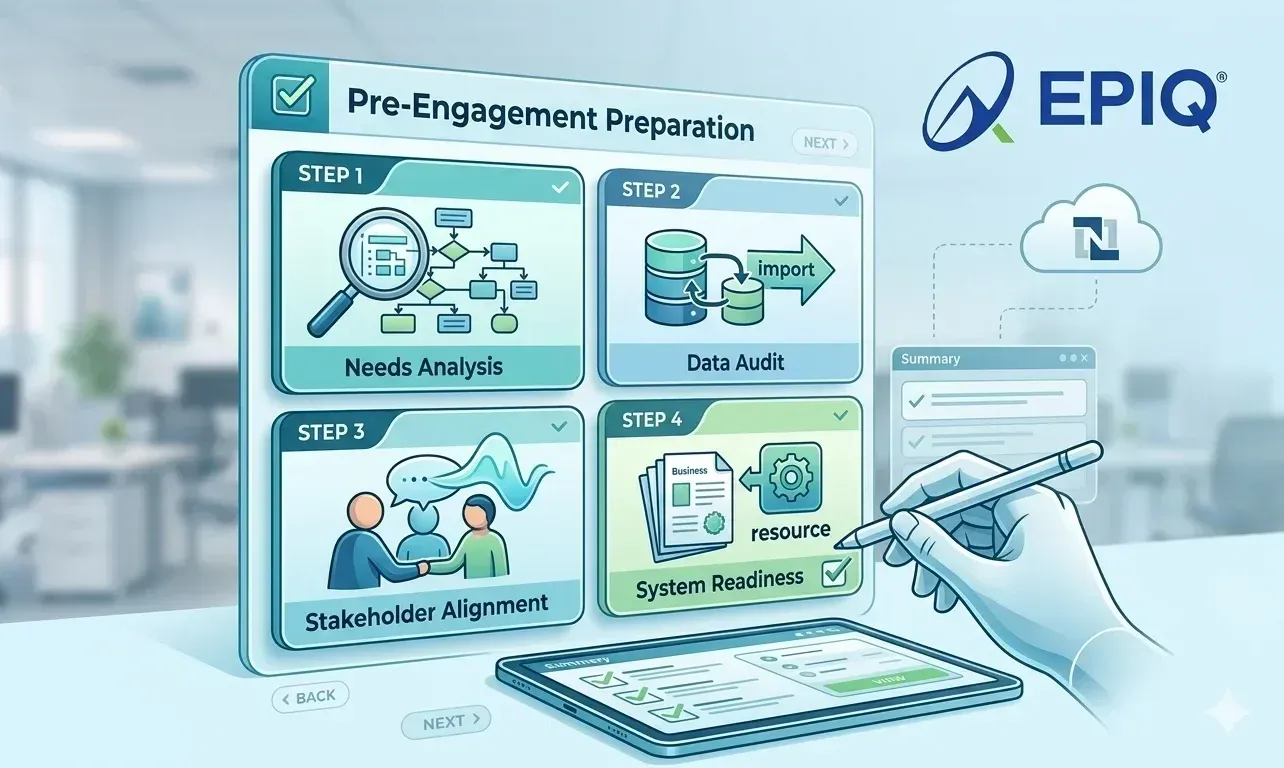
At EPIQ Infotech, we have guided dozens of businesses through NetSuite consulting engagements—from initial scoping through optimisation. This guide distils that experience into a comprehensive, downloadable checklist covering the four pillars of pre-engagement readiness: data readiness, process documentation, stakeholder alignment, and budget planning.
Whether you are preparing for a NetSuite consultant engagement for the first time or re-engaging after a stalled project, this checklist will help you walk into that kickoff meeting fully prepared.
What This Guide Covers
- Data Readiness – Audit, clean, and organise your business data before migration
- Process Documentation – Map current workflows, pain points, and automation opportunities
- Stakeholder Alignment – Build internal consensus, assign roles, and set expectations
- Budget Planning – Develop a realistic, comprehensive budget that covers the full engagement lifecycle
- The Complete Downloadable Checklist – Print-ready tables you can use in your next planning session
- Red Flags to Avoid – Common mistakes that derail engagements before they start
1. Data Readiness: The Foundation of Every Successful NetSuite Engagement
Poor data quality is the single most cited reason for ERP implementation failures. When you prepare for a NetSuite consultant, the first thing they will ask for is your data—the chart of accounts, customer master, vendor records, open transactions, inventory counts, and historical balances. If that data is scattered across spreadsheets, legacy systems, and email threads, your consultant will spend billable hours doing cleanup work instead of configuration work.
EPIQ Insight
One of our clients reduced data migration costs by 30% simply by running a data audit and deduplication exercise three weeks before the consulting engagement began.
What Data Readiness Looks Like
- Inventory your data sources. List every system, spreadsheet, and manual record that holds business-critical data. This includes your accounting software, CRM, e-commerce platform, warehouse management system, and any department-level trackers.
- Identify your master records. Determine the authoritative source for customers, vendors, items, employees, and the chart of accounts. If two systems hold conflicting customer records, decide now which one wins.
- Clean and deduplicate. Remove duplicate records, correct formatting inconsistencies (address formats, phone number styles, item SKUs), and archive inactive records. Migrate only what you need—active customers, current inventory, and open transactions.
- Validate financial balances. Reconcile your trial balance, bank accounts, accounts receivable, and accounts payable. Your opening balances in NetSuite must match your books perfectly, or your first month-end close will be a nightmare.
- Prepare data in migration-ready format. NetSuite accepts CSV imports for most record types. Start organising your data into the field structures NetSuite expects—your consultant can provide templates, but having the raw data ready accelerates the process dramatically.
Data Readiness Checklist
| ✓ | Action Item | Details / Notes |
|---|---|---|
| □ | Data source inventory | List all systems, files, and manual records holding business data |
| □ | Master record identification | Define a single source of truth for customers, vendors, items, and employees |
| □ | Deduplication and cleanup | Remove duplicates, fix formatting, standardise naming conventions |
| □ | Financial reconciliation | Reconcile the trial balance, bank accounts, AR, and AP before engagement |
| □ | Historical data policy | Decide what migrates vs. what gets archived externally |
| □ | Data mapping templates | Prepare CSV files in NetSuite’s expected import format |
| □ | Data ownership assignment | Assign a team member to own data quality throughout the project |
2. Process Documentation: Map How Your Business Actually Works
Your NetSuite consultant needs to understand your business operations before they can configure the system to support them. The most common mistake businesses make is assuming the consultant will “figure it out” during discovery. While good consultants will conduct thorough requirements gathering, the process is far more efficient—and the outcomes far better—when you arrive with documented current-state workflows.
Process documentation serves a dual purpose. First, it gives your consultant a head start on understanding how your business operates, which reduces the hours (and cost) of the discovery phase. Second, it forces your internal team to confront how things actually work versus how people think they work—a gap that often reveals significant inefficiencies and automation opportunities.
Core Processes to Document
- Order-to-Cash (O2C): How orders are received, approved, fulfilled, invoiced, and collected. Include exception handling—returns, partial shipments, credit memos.
- Procure-to-Pay (P2P): How purchase orders are created, approved, received, matched to invoices, and paid. Note any three-way matching requirements.
- Record-to-Report (R2R): Your month-end close process, journal entry workflows, intercompany eliminations, and financial reporting requirements.
- Inventory Management: How items are received, stored, picked, packed, and shipped. Include lot/serial tracking, multi-location management, and reorder point logic.
- CRM and Sales: Lead capture, opportunity management, quoting, and customer communication workflows.
- Revenue Recognition: How you recognise revenue under ASC 606 or IFRS 15, including any multi-element arrangements or performance obligations.
Documentation Format Tip
You do not need enterprise-grade process maps. A clear written description with key steps, decision points, responsible parties, and exception handling is sufficient. Use a simple template: Process Name → Trigger → Steps → Decision Points → Output → Owner.
Process Documentation Checklist
| ✓ | Action Item | Details / Notes |
|---|---|---|
| □ | Order-to-Cash workflow | Document from order entry through cash collection, including exceptions |
| □ | Procure-to-Pay workflow | Document from requisition through payment, including approvals |
| □ | Month-end close process | List every step, timeline, and responsible party for financial close |
| □ | Inventory workflows | Receiving, putaway, picking, packing, shipping, adjustments |
| □ | CRM / sales workflows | Lead-to-opportunity-to-quote-to-order process |
| □ | Revenue recognition rules | Document how revenue is recognised across product and service lines |
| □ | Pain points register | List current frustrations, bottlenecks, and manual workarounds |
| □ | Automation wish list | Identify processes that should be automated in NetSuite |
| □ | Integration requirements | List all third-party systems that must connect to NetSuite |
3. Stakeholder Alignment: Getting Everyone on the Same Page Before Day One
ERP projects fail more often due to people than to technology. A 2023 survey found that 77% of companies identified institutional leadership support as the most critical success factor in ERP implementations. Without clear alignment across departments, you get conflicting requirements, political resistance, and adoption failures that no amount of technical excellence can overcome.
Before you engage a NetSuite consultant, you need three layers of alignment: executive sponsorship (someone with authority and budget to champion the project), an internal project team (cross-functional representatives who will make day-to-day decisions), and departmental buy-in (end users who understand why this change is happening and what it means for them).
Key Roles to Define
- Executive Sponsor: A senior leader (typically CFO, COO, or VP of Operations) who owns the business case, secures budget, removes blockers, and resolves cross-departmental conflicts. This cannot be a passive role—a missing or disengaged sponsor is one of the top causes of ERP project delays.
- Internal Project Manager: The day-to-day coordinator who manages timelines, tracks deliverables, and serves as the primary liaison with the consultant. This should not be someone’s side project—assign dedicated time.
- Subject Matter Experts (SMEs): Representatives from Finance, Sales, Operations, IT, and any other department that will use NetSuite. These people provide requirements, validate configurations, and participate in User Acceptance Testing (UAT).
- Change Champion: Someone (or a small group) who drives user adoption, manages internal communications, and addresses resistance. This role is especially critical in organisations moving from spreadsheets or legacy systems.
83% of companies meet or exceed ROI expectations when they conduct pre-implementation analysis
Stakeholder alignment during the pre-engagement phase is the single biggest predictor of whether that analysis happens—and whether its conclusions stick.
Stakeholder Alignment Checklist
| ✓ | Action Item | Details / Notes |
|---|---|---|
| □ | Executive sponsor identified | Named a senior leader with budget authority and decision-making power |
| □ | Internal project manager assigned | Dedicated resources (not a part-time add-on to someone’s existing role) |
| □ | SMEs nominated per department | Finance, Sales, Operations, IT, Warehouse, HR as applicable |
| □ | RACI matrix created | Define Responsible, Accountable, Consulted, Informed for every major deliverable |
| □ | Change champion designated | Person or team responsible for internal communication and adoption |
| □ | Kickoff meeting planned | Internal alignment meeting before the consultant engagement begins |
| □ | Success criteria defined | Specific, measurable KPIs the project must achieve (e.g., close cycle reduction) |
| □ | Risk register started | Identify known risks, dependencies, and constraints before kickoff |
4. Budget Planning: Building a Realistic Financial Framework
Budget overruns are endemic to ERP projects. According to Panorama Consulting Group, only 40% of ERP implementations finish at or under budget, with the average cost overrun reaching 33%. Much of this stems from businesses underestimating the true scope of costs involved in a NetSuite engagement.
A comprehensive NetSuite consulting checklist must include a budget framework that accounts for every cost category—not just the obvious ones such as software licensing and consulting fees, but also the hidden costs that can catch organizations off guard.
Cost Categories to Budget For
- NetSuite Licensing Fees: Base platform, user licenses, and module add-ons (Advanced Financials, SuiteCommerce, WMS, etc.). Pricing typically ranges from $999 to $9,999+ per month, depending on your configuration.
- Implementation Consulting Fees: Professional services from your NetSuite partner. Expect $150–$250+ per hour for experienced consultants. Total project costs for mid-market businesses typically range from $50,000 to $250,000+, depending on scope complexity.
- Data Migration Costs: Cleaning, transforming, and loading data into NetSuite. This is often an underestimated budget for data preparation labor (internal) and migration services (external).
- Integration Development: Connecting NetSuite to your e-commerce platform, CRM, payment processor, 3PL, or other third-party systems. Middleware solutions such as Celigo or Boomi incur additional licensing costs.
- Customization and SuiteScript Development: Any workflows, scripts, or custom records that go beyond standard NetSuite configuration. Budgeting a contingency requirement often evolves during implementation.
- Training and Change Management: Role-based training for end users, administrator training for your internal NetSuite team, and change management communications.
- Internal Labor Costs: The salary cost of pulling your employees off their regular work to participate in the project. This is the most overlooked cost and often equals or exceeds external consulting fees.
- Post-Go-Live Support (Hypercare): Budget for 4–12 weeks of dedicated support after go-live to stabilize the system, address issues, and refine configurations.
EPIQ Budget Rule of Thumb
Plan for NetSuite implementation services to cost 1–3x your first year’s NetSuite licensing fees. Include a 15–25% contingency buffer for scope changes and unexpected requirements. It is far better to come in under budget than to scramble for additional funding mid-project.
Budget Planning Checklist
| ✓ | Action Item | Details / Notes |
|---|---|---|
| □ | Licensing cost estimate | Get formal quote from Oracle NetSuite or partner for base platform + modules |
| □ | Implementation services estimate | Obtain proposals from 2–3 consulting partners for comparison |
| □ | Data migration budget | Budget for both internal labour and external migration services |
| □ | Integration costs scoped | Identify every integration, estimate middleware licensing + development |
| □ | Customisation contingency | Reserve 15–25% of the implementation budget for scope changes |
| □ | Training budget allocated | Role-based training, admin training, and ongoing learning resources |
| □ | Internal labour costs calculated | Estimate hours your team will dedicate and their loaded cost |
| □ | Hypercare support planned | Budget for 4–12 weeks of post-go-live dedicated support |
| □ | Total cost of ownership (TCO) model | 3–5 year projection covering all recurring and one-time costs |
5. Red Flags: What Not to Do Before Engaging a NetSuite Consultant
Knowing what to prepare is half the battle. Equally important is recognising the patterns that set engagements up for failure. Here are the most common pre-engagement red flags we see at EPIQ Infotech.
- Skipping data cleanup and hoping the consultant will handle it. Consultants are system experts, not data entry clerks. Every hour they spend cleaning your data is an hour not spent optimizing your system.
- No executive sponsor or a passive one. Without someone who can make decisions, approve budgets, and resolve conflicts, your project will stall at every crossroad.
- Treating the ERP project as an IT initiative. NetSuite touches every department. If Finance, Sales, and Operations are not involved from day one, the system will not reflect how your business works.
- Choosing the cheapest consultant instead of the right one. An experienced consultant may cost more per hour but will deliver faster, avoid common pitfalls, and ultimately cost less. Ask for industry-specific references and case studies.
- Trying to replicate your old system exactly. NetSuite has robust built-in functionality. Over-customising to replicate legacy workflows is expensive, fragile, and defeats the purpose of moving to a modern cloud ERP.
- No defined success criteria. If you cannot articulate what “success” looks like in measurable terms (close cycle reduced by 50%, inventory accuracy above 98%), you cannot hold anyone accountable—including yourself.
6. The Complete Pre-Engagement Checklist (Print-Ready Summary)
Below is the consolidated list of all checklist items from this guide. Print this page, distribute it to your project team, and use it to track your readiness before the consulting engagement begins.
Data Readiness (7 Items)
| ✓ | Action Item | Details / Notes |
|---|---|---|
| □ | Data source inventory complete | All systems and files are catalogued |
| □ | Master records identified | Single source of truth per entity type |
| □ | Deduplication done | No duplicate customers, vendors, or items |
| □ | Financial balances reconciled | Trial balance, AR, AP, bank accounts verified |
| □ | Historical data policy set | What migrates, what’s archived |
| □ | Data in migration format | CSVs prepared in a NetSuite-compatible structure |
| □ | Data owner assigned | Named person responsible for data quality |
Process Documentation (9 Items)
| ✓ | Action Item | Details / Notes |
|---|---|---|
| □ | O2C documented | Order entry through cash collection |
| □ | P2P documented | Requisition through payment |
| □ | Month-end close documented | Every step, timeline, and owner |
| □ | Inventory workflows documented | Receiving, storage, fulfilment, adjustments |
| □ | CRM / sales workflows documented | Lead through a closed deal |
| □ | Revenue recognition rules documented | ASC 606 / IFRS 15 compliance |
| □ | Pain points registered | Current bottlenecks and workarounds |
| □ | Automation wish list created | Processes to automate in NetSuite |
| □ | Integration requirements listed | All third-party system connections |
Stakeholder Alignment (8 Items)
| ✓ | Action Item | Details / Notes |
|---|---|---|
| □ | Executive sponsor identified | Senior leader with budget authority |
| □ | Project manager assigned | Dedicated resources, not part-time |
| □ | SMEs nominated | One per major department |
| □ | RACI matrix created | Clear decision-making framework |
| □ | Change champion designated | Adoption and communication lead |
| □ | Internal kickoff meeting held | Alignment before consultant engagement |
| □ | Success criteria defined | Measurable KPIs agreed upon |
| □ | Risk register started | Known risks and mitigations documented |
Budget Planning (9 Items)
| ✓ | Action Item | Details / Notes |
|---|---|---|
| □ | Licensing quote obtained | Formal NetSuite pricing from Oracle or a partner |
| □ | Implementation proposals collected | 2–3 consulting partner estimates |
| □ | Data migration budgeted | Internal + external costs |
| □ | Integration costs scoped | Middleware + development hours |
| □ | Customisation contingency set | 15–25% buffer reserved |
| □ | Training budget allocated | Role-based + admin training |
| □ | Internal labour calculated | Team hours × loaded cost |
| □ | Hypercare support planned | 4–12 weeks post-go-live |
| □ | TCO model completed | 3–5 year total cost projection |
Conclusion: Preparation Is the Highest-ROI Investment in Your NetSuite Project
Every dollar invested in pre-engagement preparation returns multiple times during implementation. Clean data means faster migration. Documented processes mean fewer discovery sessions. Aligned stakeholders mean faster decisions. A realistic budget means no unpleasant surprises.
The businesses that get the most value from their NetSuite consultants are not the ones with the biggest budgets—they are the ones that arrive at kickoff with clarity, consensus, and commitment. This NetSuite consulting checklist gives you the framework to be one of those businesses.
Ready to take the next step? EPIQ Infotech offers a complimentary readiness assessment to help you evaluate your preparation across all four pillars before you engage a consultant. Whether you are starting from scratch or rescuing a stalled implementation, our team brings the deep NetSuite expertise and structured methodology that mid-market businesses need to succeed.
GET YOUR FREE NETSUITE READINESS ASSESSMENT
Contact EPIQ Infotech to schedule a complimentary pre-engagement review.
Visit: epiqinfo.com
About EPIQ Infotech
EPIQ Infotech (epiqinfo.com) is a trusted Oracle NetSuite solution provider specializing in implementation, optimization, and rescue services for mid-market businesses. Our team of certified NetSuite consultants brings deep industry expertise across manufacturing, professional services, retail, and e-commerce. We help businesses transform operations, improve financial visibility, and scale with confidence on the NetSuite platform.
Frequently Asked Questions
Why is preparation important before engaging a NetSuite consultant?
Preparation reduces delays, costs, and confusion during implementation. When your data is clean, processes are documented, and stakeholders are aligned, consultants can focus on configuring the system instead of spending time resolving internal issues. This often leads to faster deployments and better long-term results.
What data should be prepared before a NetSuite implementation?
Businesses should audit all data sources, remove duplicates, reconcile financial records, and decide which historical data needs to be migrated. Core records like customers, vendors, inventory items, and financial balances should be organized in a structured format that can be imported into NetSuite.
Who should be involved in a NetSuite implementation project?
A successful project usually includes an executive sponsor, an internal project manager, and subject matter experts from departments like Finance, Sales, Operations, and IT. In many cases, a change champion is also assigned to help manage communication and encourage adoption among employees.
How much does a typical NetSuite implementation cost?
Costs vary depending on company size, complexity, and required modules. Mid-market businesses often spend between $50,000 and $250,000 on implementation services. Licensing, integrations, customization, training, and internal labor should also be included in the total project budget.
What are the common mistakes companies make before starting a NetSuite project?
Some common mistakes include skipping data cleanup, lacking executive sponsorship, treating ERP as only an IT project, selecting consultants based purely on price, and trying to replicate legacy systems instead of improving processes.
What is stakeholder alignment in an ERP implementation?
Stakeholder alignment means ensuring executives, project teams, and department users all understand the goals of the implementation. Clear roles, responsibilities, and expectations prevent conflicting requirements and help the project move forward efficiently.
How long does a NetSuite implementation typically take?
Implementation timelines vary widely depending on the scope of the project. Smaller implementations may take three to four months, while complex multi-department or multi-entity deployments can take six months or longer.

Santosh Krishnamoorthy is a Principal ERP Consultant at EPIQ Infotech, with extensive experience in NetSuite and enterprise systems. He works with finance and operations teams to improve reporting accuracy, streamline workflows, and build ERP environments that support sustainable growth. His writing focuses on practical insights drawn from real implementation and support experience.
Free Consultation
Talk to a NetSuite Expert
Response within 1 hour