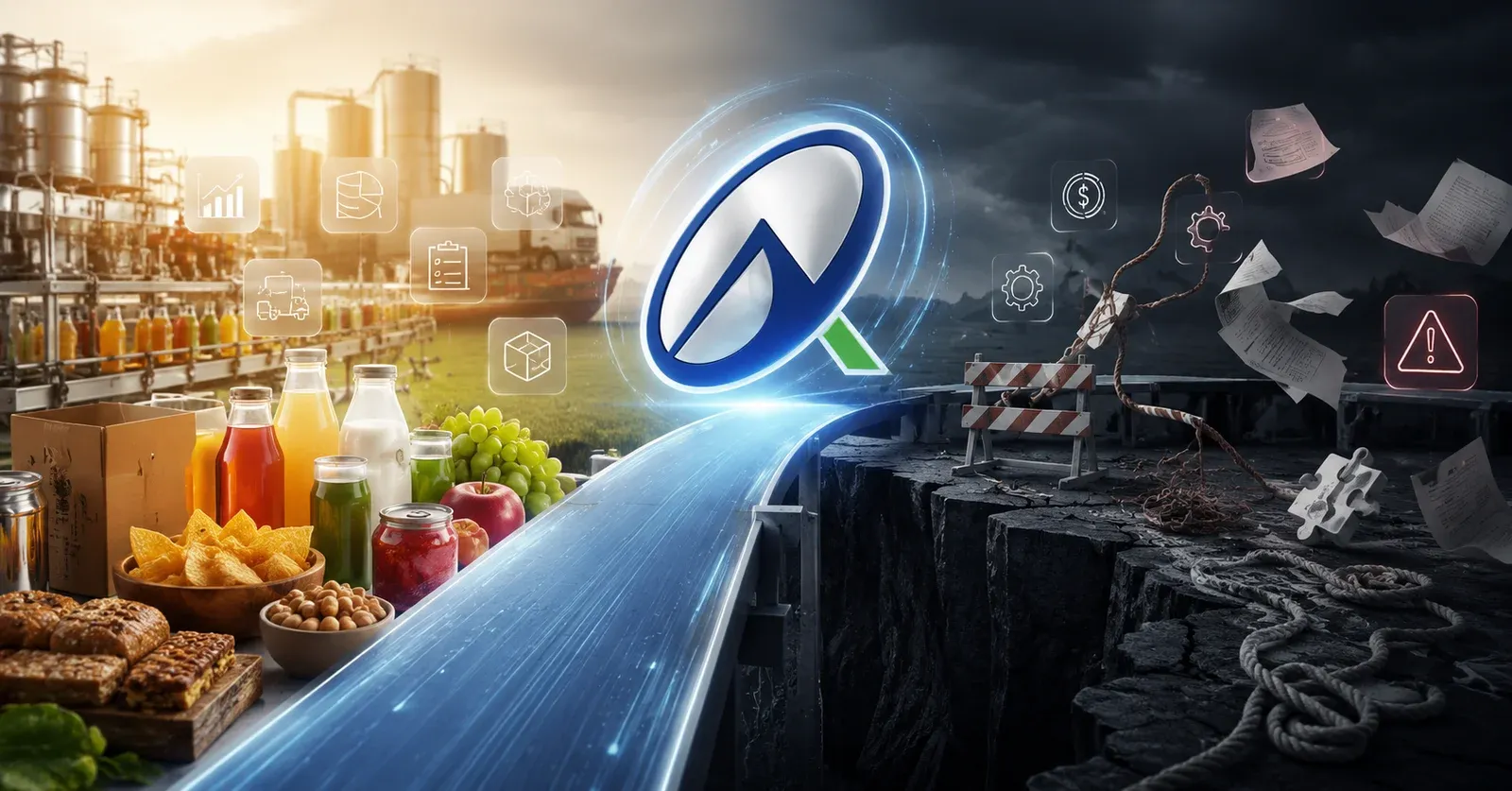
There's a moment every food and beverage operator knows.
It often begins like this, A major retail buyer is calling for a quality audit on a recent shipment. They need lot traceability — now. Your warehouse manager starts digging through binders. Your QA lead pulls up three different spreadsheets, none of which quite agree with each other. Your finance controller is running reports in the background, quietly hoping they reconcile before someone asks the wrong question.
And you're on hold. Waiting. Hoping the answer is somewhere in the mess — and that the buyer's patience doesn't run out before you find it.
That feeling — pressure-filled moment every distributor recognizes — is exactly what ERP systems like NetSuite were built to eliminate.
Not the abstract concept of 'operational inefficiency.' Not a white paper metric. That exact moment, in that exact warehouse, with that exact buyer on the line.
So, does NetSuite deliver on that promise? Genuinely — yes. But not automatically. Not without the right implementation. And not without an honest reckoning with where it falls short. This guide won't sugarcoat that. It'll tell you where NetSuite earns every dollar, where it disappoints, and how to figure out which camp your business falls into.
Why Food & Beverage Is the Hardest Industry to Run on Spreadsheets
Most industries deal with complexity. Food and beverage deals with a specific kind of complexity that makes even seasoned operations leaders reach for the antacids.
Your inventory expires. Every day that stock sits past its date is money evaporating — quietly, at the back of the warehouse, where no one is looking. Your compliance obligations aren't optional or theoretical: FSMA, FDA, HACCP — a documentation gap isn't just embarrassing, it's a legal exposure that can cost you customers, certifications, and years of hard-won reputation.
Your margins are thin enough that a 3% improvement in waste reduction can meaningfully swing profitability. But you're often flying completely blind on the data needed to find that 3%.
Then there's the supply chain. One missed supplier shipment cascades into a missed commitment to a buyer. One pricing change upstream ripples into margin erosion you only discover at month-end. One recall, without clean lot traceability, becomes a crisis that takes years to fully recover from — if you recover at all.
This is the environment NetSuite steps into. And this is precisely why the decision to implement it is never just a software decision — it's a bet on how you want to run your entire operation.
Where NetSuite Genuinely Changes Things
Let's be specific. Vague promises of 'real-time visibility' and 'streamlined operations' belong in a brochure. Here's what changes at ground level — and what it takes to get there.
✓ Lot-Level Traceability: This One Is the Real Deal
If there's one feature worth the investment for food companies operating under FDA or FSMA oversight, it's this. Every batch gets a lot number. Every lot is tied to raw material suppliers, production dates, expiry dates, quality checks, and outbound shipments — all in one place.
When a recall happens — not if, when — you don't make frantic phone calls at 7 PM. You pull a report. You know within minutes which customers received affected product, from which batch, shipped on which date. The morning panic scenario? Gone.
The system creates the possibility. Disciplined process creates reality. Every handoff point. Every shift change. A warehouse worker entering lot data at 6 AM on a Monday will do so accurately only if the process makes accuracy easy and inaccuracy visible. This distinction matters enormously when planning your implementation.
✓ FEFO Inventory Logic: Quietly Saves Real Money
First Expired, First Out sounds obvious. In practice, you'd be genuinely surprised how many food businesses are shipping newer products while older stock silently approaches expiration at the back of the warehouse.
NetSuite enforces FEFO picking logic — the system can physically prevent a warehouse picker from selecting a newer pallet when an older one needs to move first. For distributors running perishables, this single feature can eliminate thousands of dollars in monthly write-offs. Not in theory. In practice.
FEFO configuration must happen at go-live — not bolted on as a phase-two afterthought. In our experience with F&B clients, this is among the most commonly deferred items in rushed implementations, and one of the most expensive to retrofit later.
✓ Multi-Entity Consolidation: For Companies That Have Outgrown One of Everything
If you're running multiple subsidiaries, currencies, or distribution locations, this is where NetSuite's strength compounds into something transformative. A purchase order, a batch ticket, a shipment — it posts once and automatically updates everywhere: inventory, financials, order status, compliance records.
That sounds mundane until you've spent years doing each of those updates manually, in four different systems, hoping they eventually agree. One Asia-Pacific coffee distributor we work with went from financial reporting that took weeks to reporting that took days — simply by eliminating the fragmentation across six separate systems.
Technology does not fix culture. If your receiving team doesn't consistently record lot numbers because no one has ever held them accountable, NetSuite doesn't solve that. It creates a more expensive system in which the same gap continues to exist.
The Implementation Questions Nobody Asks — Until It's Too Late
Before you sign anything, put these specific questions to your prospective implementation partner. Their comfort — or discomfort — with the answers will tell you more than any demo ever will.
- How do you handle FEFO configuration at go-live — or is that typically a phase-two item for your projects?
- Which add-on modules will we realistically need that aren't included in the base quote?
- When something breaks at 5 PM on a shipment deadline, who handles it — and what's the actual response SLA?
- Can you introduce us to a reference client in food processing or distribution who went live in the last 18 months?
Capability Scorecard: What Actually Performs
| Capability | What Actually Happens | Verdict |
|---|---|---|
| Lot & batch traceability | Strong — if your team enters data at every handoff | ✓ Real strength |
| FEFO inventory enforcement | Excellent when configured at go-live (not month four) | ✓ Real strength |
| Multi-entity financials | One of NetSuite's clearest, most defensible wins | ✓ Real strength |
| variable pricing | Underrated — meaningfully shortens billing cycles | ✓ Real strength |
| Omnichannel order management | Solid core; channel integrations add complexity & cost | ✓ Solid |
| Recipe & formulation management | BOM-based; clunky for complex or variable-yield operations | ⚠ Add-ons needed |
| Demand planning in volatile markets | Basic native tools break under real F&B volatility | ⚠ Gaps exist |
| POS & third-party integration | Each connection is its own project — budget accordingly | ⚠ Plan ahead |
| Implementation cost transparency | Expect 1–2× your annual license — plan for it upfront | ⚠ Budget carefully |
Is NetSuite Actually Right for You?
The sales process is structurally designed to answer 'yes' to this question regardless of your specifics. Here's a more honest framework.
NetSuite is likely a strong fit if:
- You're a distributor, manufacturer, or multi-location operator with multiple entities, currencies, or sales channels that need consolidating.
- Compliance requirements demand audit-ready traceability you currently can't provide.
- Your system fragmentation is actively costing you time and margin — not just as a theoretical problem, but every week.
- You have the budget not just for the license, but for a properly resourced implementation and ongoing support.
Why the Right Partner Is Not Optional
Read enough NetSuite implementation post-mortems and a pattern emerges. The failures are rarely related to the software itself. They're about the gap between how a system was configured and how the business operates — a gap that only an experienced, industry-literate partner can reliably close.
Oracle's standard support carries a well-documented reputation for slow, scripted responses that don't resolve complex, time-sensitive issues. When your lot allocation logic is broken and outbound shipments are queuing up, a ticket queue is not an adequate answer.
For F&B companies specifically — where the stakes around perishable inventory, recall readiness, and compliance are genuinely high — the difference between a partner who understands your operational environment and one who doesn't is the difference between a system that runs your business and one your team eventually routes around.
Epiq Infotech is a certified Oracle NetSuite Solution Provider based in Cerritos, California — 15+ years of NetSuite expertise, 100+ successful project deliveries across manufacturing, distribution, and food processing environments.
Where Epiq's approach differs from the typical implementation playbook is in what they don't skip: FEFO configuration is addressed at go-live, not deferred. Add-on module requirements are scoped honestly in discovery, not discovered mid-project. Post-go-live, clients have access to a dedicated NetSuite managed services team — not a ticket queue — so when something breaks on a shipment deadline, there's a US-based team available to resolve it.
BOTTOM LINE
NetSuite has genuinely transformed operations for food and beverage companies. The lot traceability works. The multi-entity consolidation is excellent.
For the right company — one with the resources to implement it properly, the process discipline to maintain data quality, and operational complexity that justifies the investment — NetSuite can be the platform that finally connects the dots across inventory, finance, production, and compliance.
But it is not a magic wand. It's an infrastructure decision of the same magnitude as opening a new facility or restructuring a distribution model. It requires honest budgeting, a partner who knows both the software and your industry, disciplined change management, and a clear-eyed assessment of whether your challenges are technology problems — or people and process problems that no software alone will fix.
With the right system and the right partner, it's a goal that's genuinely within reach. The question is whether you're ready to do the work that makes it possible.
Ready to talk through whether NetSuite is the right fit?
Epiq's team works with food processors, beverage brands, snack manufacturers, dairy operations, and distributors across the USA. We'll give you an honest answer — not a sales pitch.
Schedule a Free Consultation →
Santosh Krishnamoorthy is a Principal ERP Consultant at EPIQ Infotech, with extensive experience in NetSuite and enterprise systems. He works with finance and operations teams to improve reporting accuracy, streamline workflows, and build ERP environments that support sustainable growth. His writing focuses on practical insights drawn from real implementation and support experience.
Free Consultation
Talk to a NetSuite Expert
Response within 1 hour