NetSuite Hypercare vs Managed Services: Where One Ends and the Other Has to Begin
Most US finance teams treat these as two names for the same thing. They are not. One is a temporary, time-boxed stabilization effort owned by your implementation team. The other is a permanent operating function. Confusing them is how companies end up with a fully live NetSuite account and nobody accountable for it in month four.
The Short Answer
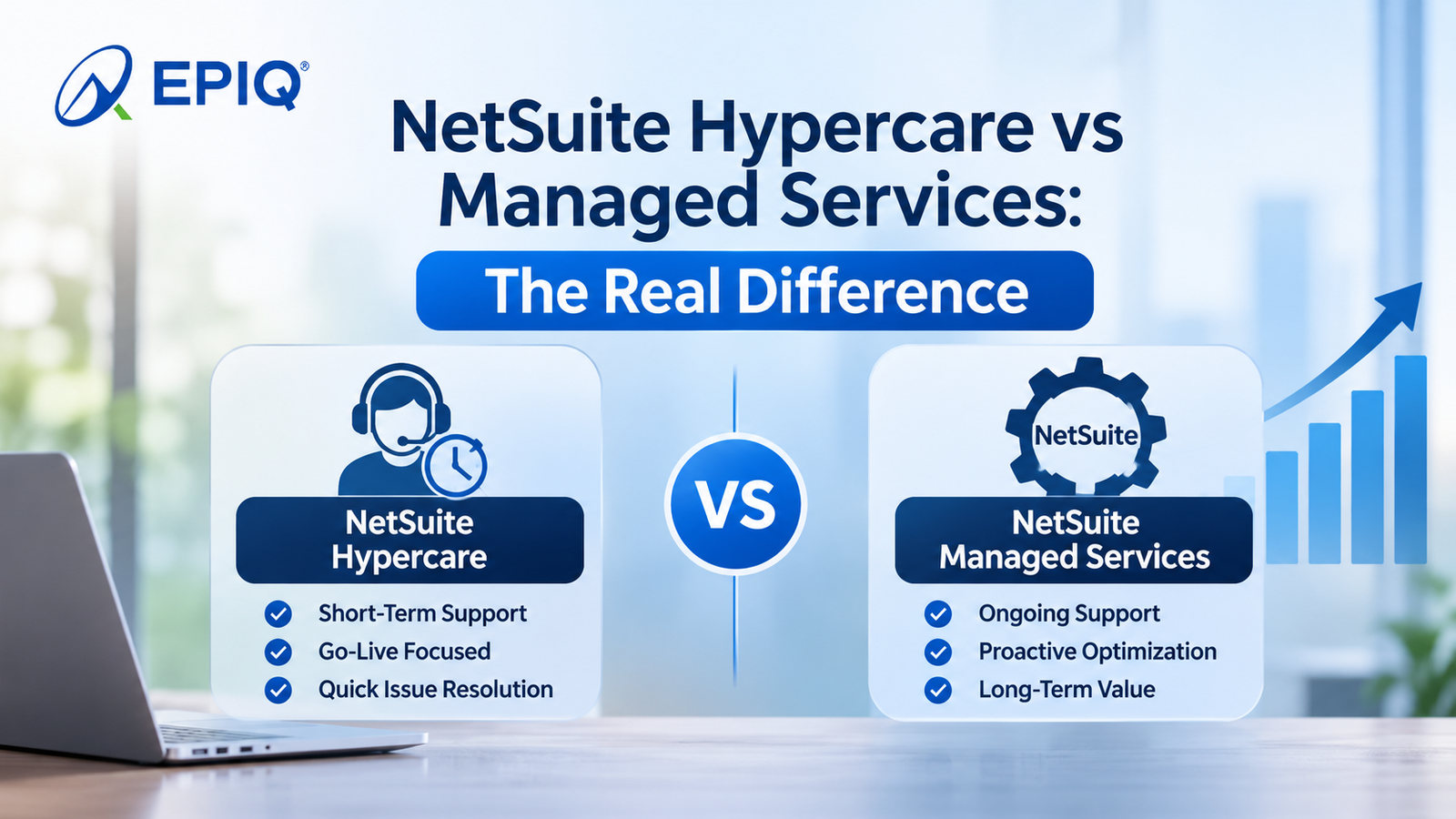
NetSuite hypercare is a temporary, elevated-intensity support period that runs immediately after go-live and ends on defined exit criteria. NetSuite managed services is an ongoing, contracted operating model with no end date. Hypercare closes out your project. Managed services runs your platform.
- Duration. Hypercare typically runs two to six weeks. Managed services runs on a rolling or annual term.
- Who owns it. Hypercare is usually staffed by the same consultants who built your account. Managed services is staffed by a standing team with documented runbooks.
- What it fixes. Hypercare fixes defects traceable to the build. Managed services handles everything that arrives after the build is accepted, including release management and new requirements.
- How it is priced. Hypercare is usually inside the implementation statement of work. Managed services is a separate retainer or hour-block agreement.
- You need both. Running hypercare without a managed services plan behind it creates a support gap at exactly the moment your team is least able to absorb one.
What is NetSuite hypercare?
NetSuite hypercare is a short, time-boxed period directly after go-live during which the implementation team stays engaged at elevated availability to resolve defects, correct configuration gaps, and stabilize daily operations in the live account. It is a closing phase of the implementation project, not a service tier.
The defining characteristic of hypercare is that it is finite and conditional. It has a start date, a target end date, and a set of exit criteria that have to be met before the project can be formally closed. Everything about it is built around one goal: proving that the account you paid to build actually works under real transaction volume, with real users, against a real month-end.
Scope during hypercare is deliberately narrow. It covers items traceable back to the implementation: a saved search returning the wrong result set, a workflow that fires on the wrong transition, an integration mapping that breaks on a specific record type, a permissions matrix that blocks a role from doing its job, a subsidiary elimination that does not balance. These are build issues. They were paid for already, and resolving them is a warranty obligation, not a new engagement.
What hypercare does not cover is equally important. New reports nobody asked for during design. A module the business decided it wants after go-live. Training for staff hired after cutover. Optimization of a process that works but could work better. Those are change requests, and treating them as hypercare tickets is the single fastest way to blow through the hypercare window with your actual defects still open.
For the full phase structure of the first 90 days after cutover, including the stabilization and optimization windows that follow hypercare, see our NetSuite post go-live support guide. This article stays focused on the boundary decision itself.
What are NetSuite managed services?
NetSuite managed services is an ongoing contracted engagement in which a certified NetSuite partner takes continuing operational responsibility for your account: administration, release testing, enhancements, integration monitoring, reporting, and user support, delivered against an agreed service level with no fixed end date.
Managed services starts from a different premise than hypercare. Hypercare assumes the system is nearly right and needs to be proven. Managed services assumes the system is correct today and will drift away from correct tomorrow, because your business will change, Oracle will ship two major releases a year, your integration partners will change their APIs, and the person who knew how the revenue recognition rules were configured will eventually take another job.
That is a structural difference, not a difference of intensity. A managed services team is built to absorb continuous change: it maintains documentation, tests each NetSuite release against your customizations in a sandbox before it reaches production, holds a backlog, and reports on it. A hypercare team is built to close a punch list and leave.
If you want the full breakdown of what sits inside a managed services engagement and how US providers structure their commercial terms, that is covered separately in our guide on how NetSuite managed services work, and on the NetSuite managed services service page.
NetSuite hypercare vs managed services: the complete comparison
Across eleven dimensions, here is where the two models genuinely differ. If you are building a post go-live budget or scoring a partner proposal, this is the table to run it against.
| Dimension | NetSuite Hypercare | NetSuite Managed Services |
|---|---|---|
| Purpose | Stabilize the account and close the implementation | Operate, protect, and improve the account continuously |
| Duration | Time-boxed, commonly two to six weeks | Open-ended, usually annual or rolling monthly |
| How it ends | Defined exit criteria are met and signed off | Contract termination or renewal, by notice |
| Who delivers it | The same consultants who built the account | A standing team working from documented runbooks |
| Scope | Defects traceable to the implementation build | Administration, enhancements, releases, integrations, reporting, user support |
| Change requests | Out of scope, logged for later | In scope, prioritized through a managed backlog |
| Response posture | Elevated and reactive, often daily standups | Mixed: proactive monitoring plus SLA-backed response |
| Release management | Not applicable within the window | Core responsibility, sandbox testing each NetSuite release |
| Commercial model | Typically inside the implementation statement of work | Separate retainer, hour block, or per-user agreement |
| Knowledge retention | Lives with the project team and leaves with them | Documented, transferable, and contractually owned |
| Success measure | Clean first close, zero critical open defects | Uptime of business process, backlog throughput, adoption |
The one-sentence test. If the question is "was this built correctly?" it is hypercare. If the question is "what should this do now?" it is managed services. Every ticket you receive in the first 60 days sorts into one of those two buckets, and sorting them honestly is what keeps your warranty window from being consumed by scope creep.
The post go-live support cliff, and why US mid-market teams fall off it
Here is the failure pattern we see most often in US mid-market accounts, and it has nothing to do with the quality of the implementation.
Hypercare ends on schedule. The project team signs off, invoices the final milestone, and rolls onto the next engagement. The internal champion who lived inside the project for seven months returns to a day job that has been accumulating in their absence. There is no managed services agreement in place because the budget conversation was deferred until "after we see how it goes."
Then week nine arrives. A bank feed stops reconciling. The controller cannot produce the consolidated report the board asked for. A new hire needs a role that nobody knows how to provision correctly. Each one is small. None is a build defect, so nobody can call the implementation team about it. And there is no standing team to call instead.
That gap is the support cliff. It is not caused by anything breaking. It is caused by accountability ending on a date while the need for accountability does not.
Companies in the $20M to $500M revenue range typically go live with a NetSuite administrator who is actually a controller, an operations manager, or an IT generalist wearing a second hat. There is rarely a dedicated full-time admin on payroll. When hypercare ends, the operational load does not transfer to a team. It transfers to one already-busy person, usually three weeks before quarter-end close.
The fix is structural, not heroic. The managed services agreement should be signed before hypercare begins, not after it ends, so that the handoff is a transition between two active parties rather than a gap between one ending and another being procured.
When should NetSuite hypercare end? Eight exit criteria
Hypercare should not end because the calendar says so. It should end because the account has demonstrably stabilized. These are the criteria we hold our own engagements to, and they are worth writing into your statement of work before go-live rather than negotiating after it.
- Zero open critical or high-severity defects Nothing that blocks a transaction type, a user role, or a reporting obligation remains unresolved. Medium and low items may remain, logged and owned.
- One full month-end close completed in production Not a test close. A real one, with real subledger activity, reconciled and reviewed by the people who will own it every month after.
- Every critical integration has run a full cycle Each interface has processed a complete business cycle in production, including error paths and reprocessing, not just a successful first transaction.
- Transaction volume has reached steady state Daily volume in the live account is within a reasonable band of pre go-live baseline. If users are still working around the system in spreadsheets, you have not stabilized, you have deferred.
- Ticket volume has flattened for two consecutive weeks A declining then flat curve is the clearest single signal that defects are exhausted rather than merely unreported.
- Every business-critical role has transacted unaided AP, AR, order entry, receiving, inventory, and close roles have each completed their core tasks without a consultant on the call.
- Documentation has been delivered and reviewed Configuration decisions, customization inventory, integration specifications, and role matrices exist as artifacts you hold, not as knowledge in a consultant's head.
- The receiving team is named and under contract Internal admin, managed services partner, or both. Named individuals, agreed response times, and an active agreement. Not an intention.
On criterion eight. This is the one most commonly skipped and the only one that is entirely within your control before the project even starts. Treat it as a gate, not a formality.
What actually transfers in the hypercare to managed services handoff
A handoff is not a status call. It is a transfer of specific artifacts and specific accountability. If your partner proposal does not enumerate these, ask for them in writing before you sign.
Artifacts that must transfer
- Configuration decision log with the rationale behind each setting
- Full customization inventory: scripts, workflows, custom records, fields, forms
- Integration specifications, endpoint inventory, and credential ownership
- Role and permission matrix mapped to named users
- Saved search and report library with business owners assigned
- Open defect and deferred-change backlog with severity and ownership
- Sandbox refresh cadence and environment inventory
Accountability that must transfer
- Named first point of contact with published response times
- Escalation path and after-hours coverage boundaries
- Ownership of the next NetSuite release test cycle
- Integration monitoring and failure alerting
- User provisioning and deprovisioning process
- Backlog triage and prioritization cadence
- Reporting rhythm to finance leadership
The cleanest handoffs we run have a two-week overlap where the managed services team is active while the hypercare team is still engaged. The incoming team takes live tickets with the outgoing team available for context. That overlap costs very little and removes almost all of the risk from the transition.
Do you need hypercare, managed services, or both?
For almost every US company going live on NetSuite, the honest answer is both, in sequence. The real decision is how long each should run and how much of the ongoing function you keep in-house. Use the scenario table below as a starting point.
| Your situation | Hypercare length | What comes next |
|---|---|---|
| Single-entity, standard SuiteSuccess build, no custom scripts, under 25 users | Two to three weeks | Light managed services retainer or a fractional administrator |
| Multi-entity or OneWorld, two or more integrations, moderate customization | Four to six weeks through one full close | Full managed services with release management included |
| Heavy SuiteScript customization, EDI, or regulated reporting obligations | Six weeks or two full closes | Full managed services plus a named technical lead |
| You already employ a full-time, experienced NetSuite administrator | Two to four weeks | Escalation-only agreement covering development and release testing |
| Migration from a stalled or failed first implementation | Extended, tied to remediation milestones | Managed services from day one, overlapping remediation |
If your situation is the last row, the sequencing changes materially and is worth reading alongside our guidance on recovering a failed NetSuite implementation.
Four US-specific factors that change the timing
1. Your fiscal calendar, not the project calendar
Hypercare should span at least one complete month-end close, and if your go-live lands near a quarter boundary it should span the quarterly close too. A US company closing on a calendar fiscal year that goes live in late November is walking into year-end close, W-2 and 1099 season, and the audit prep window all at once. That is not the moment to have your implementation team disengage.
2. Audit and controls evidence
If you are audited, subject to SOX, or preparing for a transaction, your auditors will ask who has administrative access to your financial system of record and how changes to it are approved. A managed services agreement with documented change control and segregation-of-duties discipline is far easier to evidence than an informal arrangement with whoever is available.
3. Sales tax and multi-state exposure
US companies with economic nexus across multiple states carry a tax configuration burden that does not stay static. Rates change, thresholds change, and your Avalara or equivalent connector needs ongoing attention. This is classic managed services territory, not hypercare territory, and it starts generating work almost immediately after go-live.
4. Time zone and coverage reality
A manufacturer running shifts across Pacific and Eastern time has an effective operating day well beyond standard business hours. Define coverage windows in US time zones explicitly in the agreement rather than assuming them. The same applies to escalation: know who picks up at 7pm Eastern on the last business day of the quarter.
Five mistakes that turn a clean go-live into an expensive year
- Treating hypercare as an open enhancement window. Every change request accepted into hypercare displaces a defect fix. Log them, do not absorb them.
- Deferring the managed services decision until hypercare ends. Procurement, scoping, and onboarding a partner takes weeks. Starting that process at the cliff edge guarantees a gap.
- Ending hypercare on a date instead of on criteria. A calendar date is a budget artifact. Exit criteria are an operational fact. Use the criteria.
- Letting documentation be the thing that slips. Under deadline pressure, documentation is always the first deliverable sacrificed, and it is the one that determines whether your next partner can be productive in a week or a quarter.
- Assuming your implementation partner is automatically your managed services partner. Building and operating are different disciplines with different team structures. Many firms are genuinely good at one and not the other. Evaluate the operating capability on its own terms.
How EPIQ structures the transition
EPIQ Infotech has been a certified Oracle NetSuite Alliance Partner since 2013, supporting clients across 24 countries with a 96% client retention rate. We build and we operate, and we keep the two functions deliberately distinct.
Every EPIQ implementation includes hypercare governed by written exit criteria agreed before go-live, not negotiated after it. Where a client moves into our managed services practice, we run a structured two-week overlap: the incoming team takes live tickets with full access to the build team, the artifact transfer is completed and reviewed, and the first release test cycle is owned by the operating team from the start. Clients who choose a different operating partner receive the same documentation package, because knowledge about your account belongs to you.
If you are unsure whether your current post go-live arrangement is holding, a NetSuite health check is the fastest way to get an objective read on configuration drift, open technical debt, and gaps in operational coverage.
Plan the handoff before you need it
Talk to a certified NetSuite consultant about your hypercare exit criteria and what your account actually needs after the project team rolls off. No obligation, no scripted pitch.
Schedule a Free ConsultationOracle NetSuite Alliance Partner since 2013 · US consulting team · +1 (424) 259-3747
Frequently asked questions
Is NetSuite hypercare the same as NetSuite managed services?
No. Hypercare is a temporary, time-boxed phase that closes out your implementation and ends on defined exit criteria, usually within two to six weeks of go-live. Managed services is an ongoing contracted operating model with no end date that covers administration, release management, enhancements, and user support. Hypercare resolves build defects. Managed services runs the platform after the build is accepted.
How long should NetSuite hypercare last?
Two to six weeks for most mid-market accounts, and it should always span at least one complete month-end close in production. Simple single-entity builds with few customizations can stabilize in two to three weeks. Multi-subsidiary OneWorld accounts, heavy SuiteScript customization, or regulated reporting obligations usually need the full six weeks or two closes. End hypercare on exit criteria, not on a calendar date.
Is hypercare included in a NetSuite implementation contract?
Usually yes, but the length and the scope vary widely between partners, so verify it in the statement of work rather than assuming. Check three things specifically: how many weeks are included, whether the window spans a full month-end close, and what the written exit criteria are. If exit criteria are absent, add them before signing.
What happens if we skip managed services after hypercare ends?
Accountability for the account defaults to whoever is internally available, which in most US mid-market companies is a controller or operations manager already at capacity. The common result is accumulating technical debt, untested NetSuite releases reaching production, integration failures found by customers rather than by monitoring, and a configuration that drifts away from documentation. The cost rarely shows up as a single incident. It shows up as a remediation project twelve to eighteen months later.
Can we move straight into managed services without a hypercare period?
It is possible, but it shifts build-defect resolution into a service agreement that is not priced for it. Hypercare exists because the implementation team carries context that cannot be transferred quickly, and because defects attributable to the build are a warranty obligation rather than billable operational work. Skipping hypercare usually means paying twice for the same fixes.
Should our implementation partner also provide managed services?
It is often the strongest option because the team already knows your configuration decisions and the handoff risk is near zero. It is not automatic, though. Building and operating are different disciplines. Before extending the relationship, ask about standing team structure, documented runbooks, release testing process, published response times, and references from clients who have been in their operating practice for more than two years.
What should our internal team do during NetSuite hypercare?
Transact, document, and triage. Every business-critical role should be completing real work in production without a consultant on the call, because unaided transacting is what proves stabilization. Your internal lead should be capturing configuration rationale, sorting incoming tickets into defect or change request, and sitting in on handoff sessions. Hypercare is the last period where you have direct access to the people who made every build decision.
Does hypercare cover training for new users?
Generally no. Hypercare covers defect resolution for the delivered build. Training for staff hired after cutover, role-based refresher sessions, and new process education are typically either part of the original implementation training scope or handled under a managed services agreement. Confirm which, in writing, before go-live.
Santosh Krishnamoorthy
Principal ERP Consultant at EPIQ Infotech, a certified Oracle NetSuite Alliance Partner since 2013. Santosh works with US finance and operations leaders on NetSuite implementation, post go-live stabilization, and ongoing managed services across manufacturing, wholesale distribution, and professional services. More articles by Santosh
Continue reading
- NetSuite Post Go-Live Support GuideThe full 90-day phase structure after cutover
- How NetSuite Managed Services WorkCoverage areas, commercial models, and provider selection
- NetSuite Go-Live ChecklistThe cutover plan from T-30 to first close
- Why NetSuite User Adoption Fails After Go-LiveWhat goes wrong once the project team leaves
- Technical Debt in NetSuiteWhat accumulates when nobody owns the account
- NetSuite Managed Services from EPIQOur ongoing operating practice for US clients

Santosh Krishnamoorthy is a Principal ERP Consultant at EPIQ Infotech, with extensive experience in NetSuite and enterprise systems. He works with finance and operations teams to improve reporting accuracy, streamline workflows, and build ERP environments that support sustainable growth. His writing focuses on practical insights drawn from real implementation and support experience.
Free Consultation
Talk to a NetSuite Expert
Response within 1 hour