NetSuite Module Pricing & Editions (2026): What Each Add-On Costs
Updated 2026 Written by Santosh Krishnamoorthy, Principal ERP Consultant · Reviewed by the EPIQ Infotech NetSuite Practice Team against live quotes and renewals · 9 min read
Ask why two NetSuite quotes differ by tens of thousands and the answer is almost always modules and edition.
The base platform (about $999 per month) already includes financials, order management, basic inventory and CRM. Add-on modules then layer on capability: most operational modules run $500 to $3,000 per month each, and collectively modules typically add $5,000 to $30,000+ per year. Your edition sets the base you build on. Oracle publishes no list price, so treat figures here as industry-estimate planning ranges.
Key takeaways
- Editions set the baseline; modules add capability on top. A higher edition raises your base cost; each module adds a recurring fee.
- CRM is included in the base platform, with no separate module fee, so lead-to-cash, opportunities and cases come standard.
- Modules are easy to add and hard to remove. Most can only be dropped at renewal, so license what you need now and phase in the rest.
- Each module costs more than its license fee. It also expands implementation, testing and training, so factor total effort, not just the subscription line.
- Industry suites usually beat a la carte. A SuiteSuccess bundle for your sector often costs less than licensing the same modules separately.
- 2026 AI is bundled into the platform for most editions, with no separate AI module fee.
In this guide
This guide explains what NetSuite modules and editions actually are, then breaks down what each one adds to your price with real 2026 ranges. For the total budget picture across users, implementation and support, see the NetSuite pricing hub.
1. What is a NetSuite module?
Definition: NetSuite module
A NetSuite module is an add-on that extends the core platform with specialised functionality, for example advanced financials, inventory, warehouse management, manufacturing, subscription billing, projects or commerce. Each module is licensed separately and carries its own recurring subscription fee on top of the base platform.
2. What is a NetSuite edition?
Definition: NetSuite edition
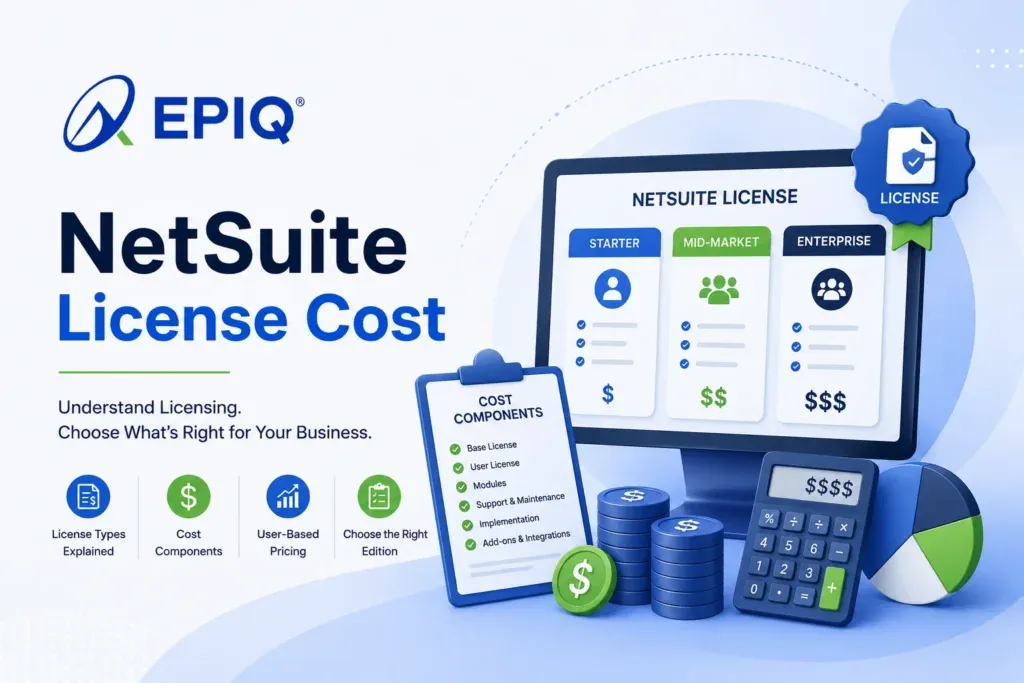
A NetSuite edition is the baseline package that sets how much business complexity the platform supports: the number of legal entities, currencies, users and transaction volume. The edition determines your base license cost. All editions run on the same codebase, so upgrading later does not require re-implementing.
Put simply, editions set your baseline and modules add capability on top. A higher edition raises your base cost; each module adds a recurring fee. Together they explain why an inventory-heavy manufacturer pays far more than a services firm of the same headcount.
3. NetSuite editions and base cost
| Edition | Best fit | Entities / users | Indicative base |
|---|---|---|---|
| Limited / Starter | Smaller companies, simple operations | Single entity, up to ~10 users | ~$999 to $2,000 / mo |
| Emerging / Mid-Market | Growing, multi-entity businesses | Multiple entities and currencies, 10+ users | ~$2,000 to $5,000 / mo |
| Enterprise | Large, global organisations | Hundreds+ of users, global ops | $5,000+ / mo (negotiated) |
OneWorld is the capability that unlocks multi-subsidiary, multi-currency consolidation, a common reason companies move from Limited to Mid-Market. For how editions interact with seat pricing, see the license cost guide.
4. What the base platform already includes
Before you license a single add-on, the base platform covers a lot. Knowing this stops you paying for capability you already have.
Included in the ~$999/month base (no separate module fee)
- Financial management: general ledger, accounts payable and receivable, close and standard financial reporting.
- Order management: quotes, sales orders, billing and basic fulfilment.
- Basic inventory: item records, single-location stock and reorder points.
- CRM: sales force automation, opportunities, marketing and customer support cases.
- Platform tools: saved searches, dashboards, basic workflows and role-based access.
5. NetSuite module pricing table
Collectively, add-on modules typically run $5,000 to $30,000+ per year depending on how many you activate and their sophistication. Here are the most common modules by category, what each adds, and its 2026 range.
| Module | What it adds | Who needs it | Indicative cost |
|---|---|---|---|
| Finance and accounting | |||
| Advanced Financials | Budgeting, allocations, statistical accounts, expense amortisation | Finance teams needing deeper control | ~$500 to $1,000 / mo |
| Advanced Revenue Management | ASC 606 / IFRS 15 revenue scheduling | SaaS, subscription, contract-driven firms | ~$500 to $1,000 / mo |
| SuiteBilling | Subscription and usage-based billing | Recurring-revenue businesses | Quoted separately |
| Fixed Assets Management | Asset lifecycle and depreciation | Asset-heavy businesses | Quoted separately |
| Planning & Budgeting | Modelling, forecasting, consolidated planning | FP&A-led finance teams | Quoted (higher tier) |
| Operations and supply chain | |||
| Advanced Inventory | Multi-location, lot and serial, demand planning | Product and distribution firms | ~$500 / mo |
| Warehouse Management (WMS) | RF scanning, wave picking, zones | Distribution and fulfilment | ~$1,000 to $2,000 / mo |
| Manufacturing | Work orders, routing, WIP, scheduling | Manufacturers | ~$600 to $2,000 / mo |
| Procurement | Approval routing, vendor management, purchasing controls | Purchasing-heavy operations | Quoted separately |
| Commerce | |||
| SuiteCommerce Standard | Functional B2B or B2C storefront | Online sellers | ~$2,500 / mo |
| SuiteCommerce Advanced | Fully custom storefront and checkout | Design-led or complex commerce | ~$5,000 / mo |
| People and projects | |||
| SuitePeople HR | Core HR and workforce management | Companies consolidating HR | ~$10 to $30 / employee / mo |
| SuiteProjects / OpenAir PSA | Project management, resourcing, timesheets | Services organisations | ~$25 to $50 / user / mo |
| Analytics | |||
| Analytics Warehouse (NSAW) | Pre-built data warehouse and dashboards | Data-led reporting needs | Quoted (some editions bundle) |
| SuiteAnalytics Connect | ODBC / JDBC access for external BI tools | Teams using external BI | Separate line item |
6. Which modules your industry typically needs
The fastest way to right-size a module list is to start from your operating model. These are the modules most companies in each sector license first.
| Business type | Modules most often licensed |
|---|---|
| Manufacturer | Manufacturing, Advanced Inventory, WMS, Planning & Budgeting |
| Wholesale distributor | Advanced Inventory, WMS, Procurement |
| SaaS / subscription | Advanced Revenue Management, SuiteBilling, Advanced Financials |
| Professional services | SuiteProjects / OpenAir PSA, Advanced Financials |
| Retail / ecommerce | SuiteCommerce, Advanced Inventory |
| Multi-entity / global | OneWorld (edition), Advanced Financials, Advanced Revenue Management |
This is a starting point, not a prescription. The right list depends on your specific processes, which is exactly what a scoping conversation resolves.
7. SuiteSuccess industry bundles
Rather than assembling modules piece by piece, many companies adopt an industry-tailored SuiteSuccess bundle with pre-built roles, dashboards and workflows for their sector. Bundled pricing usually beats a la carte and can shorten implementation. Before licensing a module separately, check whether your SuiteSuccess edition already includes it. See EPIQ's explainer, What is SuiteSuccess?
8. Third-party SuiteApps
Beyond Oracle's own modules, the SuiteApp marketplace offers third-party extensions: tax engines, shipping, industry-specific tools, each with its own licensing cost. They are often the most efficient way to add a niche capability, but each adds a recurring line and an integration point to maintain. Weigh a SuiteApp against a native module on both fit and total cost, not license price alone.
9. AI features in 2026
From the 2026 releases, Oracle bundles many AI capabilities, including intelligent matching, anomaly detection, predictive forecasting and generative assists, into the platform rather than charging separate module fees. A few items still sit in higher-tier modules or as separate connectors, so when negotiating, ask explicitly which AI features are included in your edition. It varies by contract and is a useful negotiation lever.
10. How to choose what to buy
- Buy for year-one needs. You can activate more modules as you grow; over-buying locks in cost you may not use.
- Separate "must-have to operate" from "nice to have later." Only the first group belongs in the initial contract.
- Check the bundle first. Confirm whether a SuiteSuccess edition already includes what you are about to license separately.
- Factor implementation effort per module, not just the license fee.
- Have a partner validate the list. EPIQ's consulting team maps modules to your actual processes.
Not sure which modules and edition you actually need?
EPIQ Infotech is a certified Oracle NetSuite Alliance Partner. We will map your processes to the right edition and modules, so you pay for capability you will use, not a wish-list.
Talk to a NetSuite Pricing Expert Get a module recommendationFrequently asked questions
How much do NetSuite modules cost?
Collectively, add-on modules typically run about $5,000 to $30,000+ per year, depending on how many you activate. Most operational modules run $500 to $3,000 per month each, on top of the base platform license.
What is the difference between a NetSuite edition and a module?
The edition sets your baseline capacity for business complexity such as entities, currencies and users, while modules bolt specific capabilities like inventory or manufacturing onto that base. A higher edition raises the base cost; each module adds a recurring fee.
What are the NetSuite editions?
Broadly a Limited or Starter edition for smaller single-entity companies, an Emerging or Mid-Market edition for multi-entity businesses, and an Enterprise edition for large global organisations. All run on the same codebase, so you can upgrade without re-implementing.
Is CRM a paid module in NetSuite?
No. Core CRM is included in the base platform, so there is no separate CRM module fee. You still pay per-user licenses. Dedicated CRM depth beyond the built-in functionality may warrant a specialist tool.
How much does the NetSuite Manufacturing module cost?
The Manufacturing module typically runs about $600 to $2,000 per month depending on scope, with Advanced Manufacturing priced higher and quoted per deal. It adds work orders, routing, WIP tracking and production scheduling.
How much does SuiteCommerce cost?
SuiteCommerce Standard runs about $2,500 per month and SuiteCommerce Advanced about $5,000 per month, before implementation. Advanced allows full custom design and checkout, so its implementation cost is also substantially higher.
What is SuiteSuccess?
An industry-tailored bundle of pre-built roles, dashboards and workflows that can shorten implementation and often costs less than licensing the same modules separately.
Do I need every NetSuite module at go-live?
No. License the modules you need to operate in year one and activate additional ones as you grow. This keeps both subscription and implementation cost down.
Santosh Krishnamoorthy
Principal ERP Consultant at EPIQ Infotech, with extensive experience in NetSuite and enterprise systems. He works with finance and operations teams to scope the right module and edition mix, streamline workflows and build ERP environments that support sustainable growth. This guide is maintained by EPIQ consultants who scope, implement and support NetSuite for mid-market and enterprise clients; ranges are reviewed against live quotes and renewals.
Sources and references
- Oracle NetSuite, product modules overview: netsuite.com products
- Oracle NetSuite, official pricing enquiry: netsuite.com pricing
- G2, verified NetSuite reviews: g2.com/products/netsuite
- Capterra, NetSuite listing: capterra.com/p/74720
Figures throughout are industry-estimate ranges for planning purposes. Oracle does not publish an official NetSuite price list; every quote is configured and negotiated, so treat these as planning ranges, not quotes. Ranges are reviewed by the EPIQ NetSuite Practice Team against live client quotes and renewals.
Continue in the NetSuite Pricing series

Santosh Krishnamoorthy is a Principal ERP Consultant at EPIQ Infotech, with extensive experience in NetSuite and enterprise systems. He works with finance and operations teams to improve reporting accuracy, streamline workflows, and build ERP environments that support sustainable growth. His writing focuses on practical insights drawn from real implementation and support experience.
Free Consultation
Talk to a NetSuite Expert
Response within 1 hour