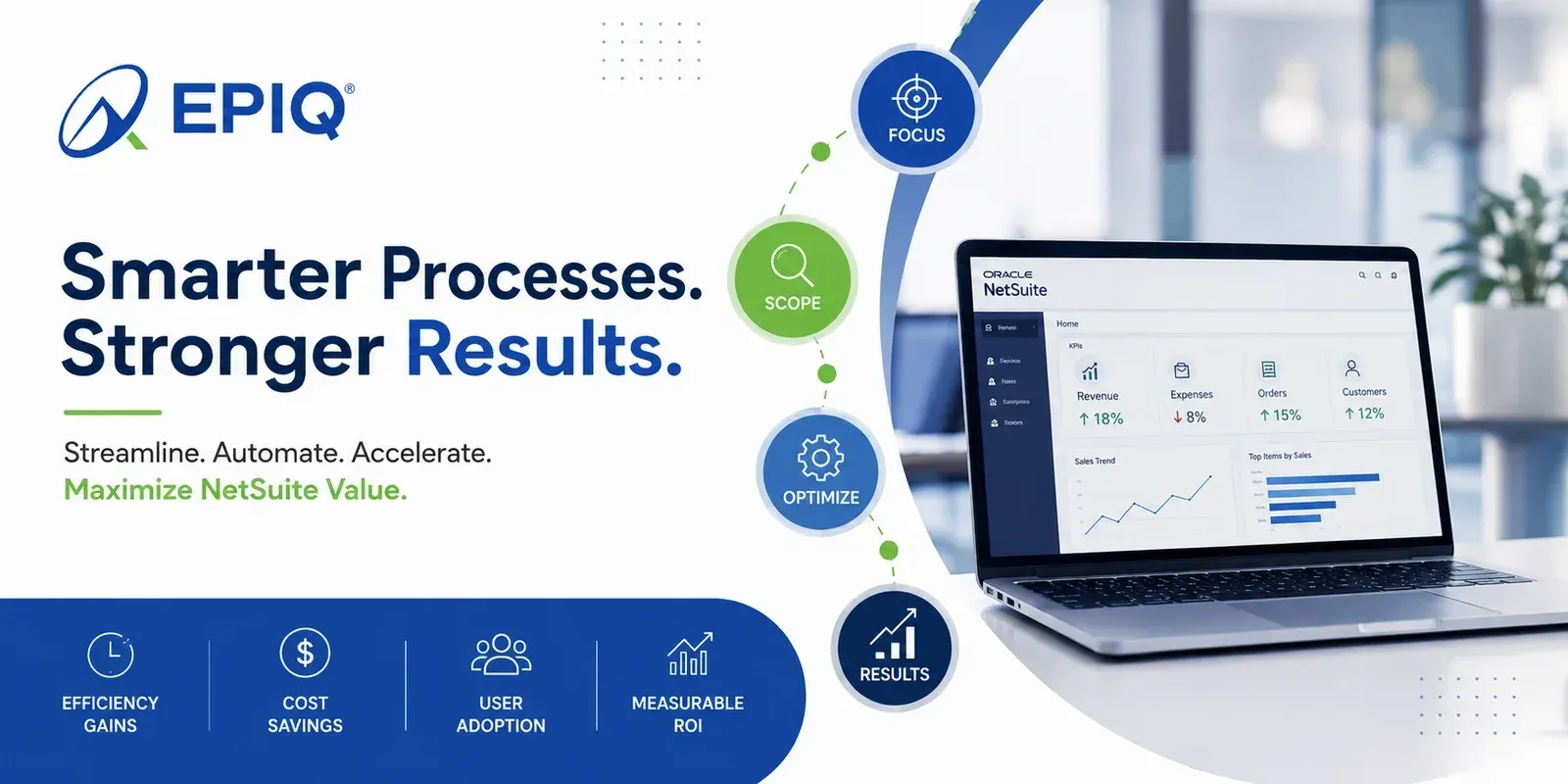
A practical guide to scoping an optimisation engagement properly — and what real ROI looks like when the work gets done well.
You Bought NetSuite. So, Why Does It Still Feel Broken?
You didn't spend six figures on NetSuite to watch your finance team export everything into Excel at month-end. You didn't go through months of implementation to hear your ops manager say, "We just have a workaround for that." And you certainly didn't sign that Oracle contract so your admin could spend Tuesday afternoons manually reconciling numbers that a properly configured system should reconcile automatically.
Yet here we are.
If this sounds uncomfortably familiar, you're in far better company than you might think. Oracle's own data shows that over 80% of businesses that adopt cloud ERP report improved efficiency, but that number comes with a catch nobody puts in the brochure: those improvements only materialise when the system is properly configured and actively maintained.1
Of businesses that adopt cloud ERP report improved efficiency — but only when the system is properly configured and actively maintained.Oracle · 2024
The uncomfortable truth is that most NetSuite environments drift. Not dramatically, not overnight — but steadily, quietly, one workaround at a time. An approval workflow gets too complex. A saved search starts timing out. A module gets turned on but is never properly configured. A business process changes, but NetSuite doesn't. And before long, the gap between what NetSuite is theoretically capable of and what your team is actually getting from it becomes the single most expensive inefficiency in your organisation.
That gap has a name. And it has a solution.
What a NetSuite Process Optimisation Engagement Actually Is
Let's be clear about what this is and isn't.
A process optimisation engagement is not a re-implementation. It is not starting over. It is not a crisis intervention for a system that's falling apart. Most companies that come to us for one are running NetSuite perfectly adequately — they're just running it at 50% of its capability, and they've stopped noticing because that's become normal.
What an optimisation engagement does is apply a structured, diagnostic lens to your live NetSuite environment and then fix what it finds. A well-run engagement covers four intersecting layers:
- Configuration audit — Are your workflows, forms, roles, and permissions built for how your business actually operates today, or how it operated when you went live two (or five) years ago?
- Process alignment — Where are your teams stepping outside NetSuite to complete work that the system should be doing? Every spreadsheet, every manual email approval, every "we just do it this way" is a signal worth investigating.
- Performance optimisation — Scripts, saved searches, integrations, and customisations all accumulate. Some degrade over time. Some conflict with each other. Some were built for a business you no longer run. A performance audit surfaces what's slowing you down.
- Adoption and usability — A 2023 survey found that only around 26% of employees in NetSuite organisations actually use the system regularly. The rest of the route around it. That's not a people problem — it's a configuration and training problem, and it has a measurable cost.
Only around one in four employees in NetSuite organisations actually use the system regularly. The rest route around it.Industry Survey · 2023
Five Signs You Need One (Even If You Think You Don't)
You don't need to be in crisis to need an optimisation engagement. In fact, the companies that benefit most are often the ones that think they're fine. Here are the red flags worth taking seriously:
-
Your month-end close is taking longer than five days
If your close has crept from five days to eight to ten, that's not your team getting slower — it's your system accumulating inefficiency. Approval chains with too many handoffs, workflows that require unnecessary manual steps, and reporting queries that take minutes to run — these are all fixable.3
-
Your team has "workarounds" for things that should be automatic
If someone on your finance or ops team says the phrase "we just have a workaround for that," write it down. Then count how many times you hear it in a week. Each one represents a configuration gap that's costing you time, accuracy, or both.
-
Your dashboards show different numbers than your reports
This is one of the most corrosive things that can happen in a NetSuite environment. When executives stop trusting the data in the system, they stop using it for decisions — and at that point, you're paying for an ERP you've essentially stopped believing in.4
-
You've gone through a major business change since go-live
A new product line. An acquisition. A new fulfilment model. A shift from project-based to subscription revenue. NetSuite didn't automatically reconfigure itself when your business changed. That gap, over time, compounds.
-
Your power users have left
This is the quiet killer. The person who knew how everything was configured, why certain workflows were built the way they were, and where all the edge cases lived — if they've moved on, that institutional knowledge walked out with them. What's left is a system that nobody fully understands.
How to Scope an Optimisation Engagement (Without Wasting Anyone's Time)
Poorly scoped consulting engagements are the reason "we hired a consultant" sometimes becomes a cautionary tale. The scope is where most engagements go wrong — either too broad (no clear deliverables, endless discovery, ballooning hours) or too narrow (fixing one symptom without addressing the cause). Here's how to scope one properly.
Step 01 / DiscoverStart with a Discovery Conversation, Not a Feature List
Before any consultant touches your system, you should be doing two things: writing down the specific symptoms your team is experiencing, and mapping the business processes that matter most to you. Not "we want to use more of NetSuite" — that's a wish, not a scope. Think in specifics:
Our AP team manually matches invoices to POs three times a week.
Our sales order approval takes an average of four days because of how our workflow is built.
We can't trust our inventory numbers at month-end because of how stock adjustments are recorded.
Those are scope inputs. A good consulting partner will use them to map back to the root causes in your configuration.
Step 02 / DefineDefine What Done Looks Like Before You Start
One of the most important questions to answer before signing a statement of work is: how will we know this engagement was successful? If you can't answer it, the scope isn't tight enough. The benchmark-setting happens here — what does your close cycle look like today, and what should it look like in 90 days? What does your AP matching rate look like now, and what's the target?
This isn't pedantry. A structured approach to benchmarking is what separates an engagement that delivers measurable ROI from one that produces a slide deck and a vague sense of improvement.
Step 03 / BoundDecide What's In and What's Out
Not every problem needs to be solved in one engagement. In fact, trying to solve everything at once is one of the most reliable ways to solve nothing. A well-scoped optimisation engagement is intentionally bounded.
A typical mid-market NetSuite optimisation engagement has a defined scope that might include three or four of the following workstreams — not all of them:
- Financial close cycle review and workflow streamlining
- Role and permission audit with remediation
- Custom script and saved search performance review
- Dashboard and KPI configuration for executive visibility
- Integration health check (e.g., Celigo, SPS Commerce, Salesforce connector)
- User adoption review and targeted training plan
- Module utilisation assessment (identifying licensed modules that aren't being used)
Trying to do all of these simultaneously without a phased approach is how scope creep starts. A good partner will help you prioritise by impact and risk.
Step 04 / ModelChoose the Right Engagement Model
There are three engagement models worth understanding before you commit to one:
Fixed scope. Fixed price. 4–12 weeks.
A fixed scope, fixed deliverables, fixed timeline. Best for organisations with a clearly defined set of problems and a desire for a specific outcome with minimal ongoing commitment.
The risk: if new issues surface during the engagement (they often do), you'll need a change order.
Set hours per month. 6–12 months.
A set number of consultant hours per month over 6–12 months. Best for organisations that know they have ongoing optimisation needs and want access to expertise without the overhead of repeated procurement cycles.
More flexible, more responsive to emerging needs.
Continuous oversight + optimisation.
For organisations that want continuous NetSuite oversight, proactive monitoring, and optimisation as an ongoing practice rather than a periodic event.
This model is increasingly the standard for mid-market companies that have learned — often the hard way — that ERP optimisation is not a one-time exercise.
What ROI Actually Looks Like
We want to be honest here, because the internet is full of ERP ROI numbers that border on marketing fiction. So let's anchor to what the data actually shows, and what we've seen in practice.
The headline number: Among organisations that performed an ROI analysis before engaging a consultant and had been live for more than a year, 83% said their projects met or exceeded ROI expectations. That's a high success rate — but notice what it's conditional on. Pre-engagement ROI analysis. Knowing what you're trying to achieve before you start is what drives that outcome, not the engagement itself.
Of organisations that performed an ROI analysis before engaging a consultant said their projects met or exceeded ROI expectations.Conditional on doing the analysis up front
What operational ROI typically looks like in a NetSuite optimisation context:
- Organisations that properly optimise their ERP workflows report an average 66% improvement in operational efficiency
- Companies working with experienced consultants on optimisation achieve an 85% success rate versus significantly lower rates with internal-only efforts
- Month-end close times reduced from 10+ days to 4–5 days are consistently reported by organisations that undertake structured workflow optimisation
- Workflow automation ROI — which is typically one deliverable within a broader optimisation engagement — averages 30–200% in year one, with some high-impact initiatives paying back within six weeks
What You Should Expect from EPIQ in an Optimisation Engagement
At EPIQ Infotech, we've been delivering NetSuite consulting and managed services since before optimisation was a category anybody talked about. Our team has seen what a well-built NetSuite environment looks like, and we've seen what a neglected one looks like. Most of the time, the gap between the two isn't technical sophistication — it's just accumulated drift and a lack of structured attention.
Here's how we approach an optimisation engagement:
Phase 01 / Weeks 1–2Discovery and Current State Mapping
We interview stakeholders across finance, operations, and IT. We access your environment directly and run a structured audit across configuration, performance, data integrity, and process alignment. We're not looking for quick wins to show you in week one — we're looking for root causes.
Phase 02 / Week 3Findings and Prioritised Roadmap
We present what we found, what it's costing you in measurable terms, and a sequenced action plan — prioritised by business impact, not technical complexity. You decide what to approve. You own the roadmap.
Phase 03 / Weeks 4–10Remediation and Configuration Work
Our team makes the changes. Every change is tested in your sandbox before it touches production. We don't move fast and break things in a live ERP environment.
Phase 04 / Close-outHandoff and Documentation
When the engagement closes, you get documentation of what was changed, why, and how to maintain it. Not a knowledge vacuum.
Phase 05 / OngoingPost-engagement Support
For most clients, an optimisation engagement opens the door to an ongoing advisory or managed services arrangement. Not because we engineered it that way — but because once you've seen what a properly maintained NetSuite environment looks like, going back to ad hoc support feels like a step backwards.
Before You Scope Anything: Start with a Health Check
If you're not sure where to start, you're not alone. Most companies that come to us already know something isn't right, but they don't know what, or whether the problem is worth the investment of a full optimisation engagement.
That's exactly what our NetSuite Health Check is designed for. It's a structured, bounded assessment of your current environment: configuration, performance, data quality, integration health, and process gaps. It takes two weeks. At the end, you have a clear picture of what your system looks like today, what the highest-impact opportunities are, and what a scoped engagement to address them would involve.
It's not a sales exercise. Some clients come out of a Health Check and decide to fix things internally. Some use it to scope an engagement with us. Some use it to have an informed conversation with their existing support partner. All of those are good outcomes — because the worst thing you can do is nothing.
If your team has learned to work around NetSuite rather than through it, the cost isn't a support ticket. It's the compound interest on a misconfigured system — paid every single day in time, accuracy, and opportunity.
No pitch deck. No feature comparison. Just a direct conversation.
If you're an existing NetSuite user and you've been reading this thinking "this is us," let's have a conversation. Just a direct conversation about where your system is, where it should be, and what it would take to close that gap.
Schedule a Free 30-Minute Consultation →Or start with our NetSuite Health Check — a structured diagnostic that gives you clarity before you commit to anything.

Santosh Krishnamoorthy is a Principal ERP Consultant at EPIQ Infotech, with extensive experience in NetSuite and enterprise systems. He works with finance and operations teams to improve reporting accuracy, streamline workflows, and build ERP environments that support sustainable growth. His writing focuses on practical insights drawn from real implementation and support experience.
Free Consultation
Talk to a NetSuite Expert
Response within 1 hour