If you are a CFO, you have heard "AI agents" enough times to be tired of it. Most of what gets called an agent is a chatbot with a new label. NetSuite SuiteAgents are different in one specific way that matters to finance: they do not just answer questions, they carry out multi-step work inside your ERP, under your approvals. This guide explains what SuiteAgents are, where they already help finance teams, where they do not yet, and how to pilot them without betting the close on unproven automation.
The short version for CFOs
- SuiteAgents are AI workers built into NetSuite that complete multi-step tasks, not just answer questions.
- They work inside your existing roles, permissions, and approvals, and every action is logged in the audit trail.
- The strongest early finance use cases are collections, expense processing, invoice matching, and close support.
- The real risk is not security. It is bad data and handing over judgment too early.
- Start with one narrow, high-volume task in review-and-approve mode, then expand once it earns trust.
What are NetSuite SuiteAgents?
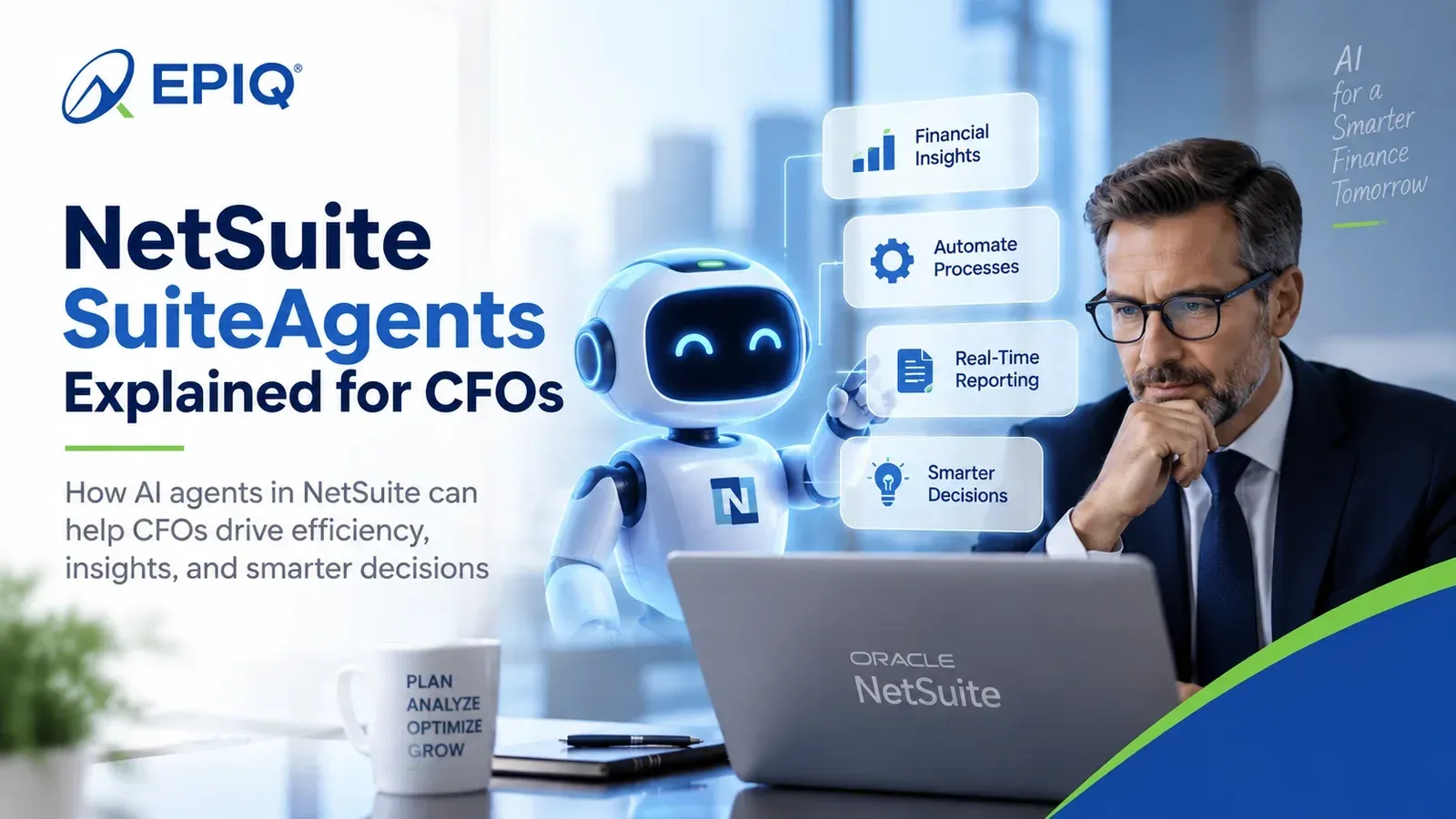
NetSuite SuiteAgents are AI agents built into NetSuite that can analyze your business data and take action on your behalf across multiple steps of a process. Announced at SuiteWorld 2025, they go beyond answering questions: an agent can read a record, decide what to do, and complete a task such as following up on an overdue invoice or matching a payment, all inside NetSuite and under your existing permissions and approvals.
Think of a SuiteAgent as a junior finance staffer who never sleeps, follows your rules exactly, and writes down everything it does. It does not have its own login to a separate system. It lives inside NetSuite, sees only what its assigned role allows, and hands the hard calls back to a person. That last part is the point most coverage misses, so it is worth being precise about how these differ from what you already have.
The key differenceSuiteAgents vs the automation you already have
The difference between SuiteAgents and traditional NetSuite automation is the difference between following rules and handling judgment. Workflows and SuiteScript do exactly what you programmed: if this, then that. A SuiteAgent reads the situation, reasons about what should happen across several steps, and can adapt to exceptions, while still stopping for human approval on anything that matters.
| Workflows and SuiteScript | SuiteAgents | |
|---|---|---|
| Trigger | A fixed condition you set in advance | A goal or request, read in context |
| Logic | Rules you program | Reasoning over live data across modules |
| Scope | One defined action | Multi-step processes, end to end |
| Exceptions | Only what you scripted | Can handle ambiguity, within limits |
| Control | Predictable by design | Human review, approvals, permissions |
Both still matter. Rule-based automation is the right tool for deterministic, high-volume, compliance-sensitive steps, and it is not going away. Agents add value where judgment and multi-step coordination used to require a person. If you want the foundation these agents build on, our guide to NetSuite workflows covers the rule-based layer.
Where it helps financeWhat can SuiteAgents do for finance teams?
This is the part CFOs actually care about. Oracle and its partners are targeting agents at the repetitive, multi-step work that eats your team's time. Here are the finance areas where agents are showing up first.
Collections and cash application
A collections agent can work through overdue invoices, draft and send reminder emails on your schedule, and prioritize which accounts to chase, so your team spends time on the hard conversations instead of the list.
Expense and vendor bill processing
Agents can read incoming bills and expense reports, extract the details, check them against policy, and prepare them for approval, cutting the manual keying that clogs accounts payable.
Invoice and bank matching
This is one of the most concrete wins. In a SuiteWorld demonstration, Oracle showed AI matching roughly 85% of accounts payable bills automatically, leaving people to handle only the exceptions. Applied to reconciliation, that shortens the close and shrinks the pile of unmatched items.
Close support and exception flagging
Agents can move through close checklists, watch for anomalies during the period rather than at the end, and flag exceptions early. For multi-entity finance teams, that includes routine intercompany reconciliation steps that normally soak up days.
Cash flow forecasting and anomaly detection
Partner-built finance agents already pair a cash flow forecasting agent with an expense anomaly detector that continuously watch billing and spending data and surface issues without being asked.
A grounded example: at SuiteWorld 2025, one demonstrated agent handled a full equipment-return incident on its own: it pulled the rental contract, checked the replacement policy, created a no-charge return, issued a replacement order, ran a margin check, and emailed the customer, logging every step in NetSuite. Swap in a finance process and you can see the shape of what is coming.
Wondering which SuiteAgents fit your finance team?
EPIQ can map the repetitive, multi-step work in your close and AP cycle to the agents that are ready today, and tell you which ones to skip for now.
Book a free consultationWhat SuiteAgents cannot do yet
Here is the honest part, because a CFO needs the caveats more than the hype. SuiteAgents are real and useful, but they are early, and treating them as a finished autopilot is how projects go wrong.
- They are not fully autonomous. The mature use cases run in review-and-approve mode. An agent proposes or prepares, and a person signs off. That is a feature, not a limitation, for anything touching the ledger.
- They inherit your data problems. An agent reasoning over duplicate vendors, blank fields, and inconsistent coding will produce confident, wrong output. Clean data is a prerequisite, not a nice-to-have.
- Availability varies. As of 2026, Oracle has begun making some finance-related agents generally available while others are in preview and expanding with each release. What is live for your account depends on your version and region, so confirm before you plan around it.
- The ambitious stuff is still maturing. Fully autonomous, multi-step agents that reach deep into custom records are realistically twelve to twenty-four months from being production-ready for most accounts.
None of this is a reason to wait on the sidelines. It is a reason to start small and deliberately. For a wider view of what is ready versus what is marketing, see our take on what actually works in NetSuite AI.
GovernanceAre SuiteAgents safe? What CFOs should ask
SuiteAgents operate inside NetSuite's existing security, role-based permissions, and audit trail. They do not bypass controls, they cannot see data their assigned role cannot see, and every action they take is logged for review. The bigger risk for finance is not the security model. It is data quality and over-delegation, handing agents judgment before their output has been proven in your environment.
Surveys of agentic AI projects find that most struggle on trust, governance, and data rather than on the technology. So the CFO's job here is governance, not coding. Before you switch anything on, get clear answers to these:
- Which specific actions can the agent take, and which require a human approval?
- What role and permissions does the agent run under, and who owns that role?
- How is every agent action logged, and can our auditors review it?
- What is our data quality in the area the agent will touch?
- What is the fallback when the agent is unsure or wrong?
How a CFO should pilot SuiteAgents
You do not need a transformation program to begin. The teams that succeed pick one narrow job and prove it. Here is a sensible path.
- Pick one high-volume, low-judgment task, such as collections reminders or expense report intake.
- Check your data quality in that area first, and fix the obvious gaps. A NetSuite health check surfaces what would trip an agent up.
- Run the agent in review-and-approve mode, so a person signs off on every action at first.
- Measure a real number: hours saved, days off the close, or match rate.
- Set the governance rules for what the agent may do on its own once it has earned trust.
- Expand to the next task only after the first one is proven in production.
This is the same sequencing discipline that makes any NetSuite AI adoption work, and it pairs naturally with tightening your financial close and reconciliation with NetSuite AI.
Want a SuiteAgents pilot that actually ships?
EPIQ helps finance teams choose the right first agent, get the data ready, set the governance, and measure the result, so your pilot proves value instead of stalling.
Talk to a NetSuite AI specialistHow SuiteAgents fit into NetSuite Next
SuiteAgents are one piece of NetSuite Next, Oracle's AI-led reinvention of the platform that also includes the Ask Oracle assistant and the redesigned Redwood experience. Agents are the "take action" layer, Ask Oracle is the "ask a question" layer, and both read from the same NetSuite data. If you are getting oriented, start with our overview of NetSuite Next and our primer on NetSuite AI, then come back to agents when you are ready to automate a process.
FAQNetSuite SuiteAgents: frequently asked questions
What are NetSuite SuiteAgents in simple terms?
SuiteAgents are AI agents built into NetSuite that complete multi-step tasks on your behalf, such as chasing overdue invoices or matching payments. Unlike a chatbot that only answers questions, an agent reads a situation, decides what to do, and takes action inside NetSuite under your permissions and approvals.
How are SuiteAgents different from NetSuite workflows?
Workflows and SuiteScript follow fixed rules you program in advance. SuiteAgents reason over live data, handle multi-step processes, and adapt to exceptions, while still stopping for human approval. Rule-based automation remains best for deterministic, high-volume steps.
What can SuiteAgents do for a finance team?
The strongest early finance use cases are collections follow-up, expense and vendor bill processing, invoice and bank matching, close support with exception flagging, and cash flow forecasting. They target the repetitive, multi-step work that normally consumes staff time.
Are SuiteAgents safe for financial data?
Yes, within limits. They run inside NetSuite's existing roles, permissions, and audit trail, cannot see data their role is not allowed to see, and log every action. The larger risk is data quality and over-delegation, so mature use runs in review-and-approve mode with clean data.
Are NetSuite SuiteAgents available now?
Some are. As of 2026, Oracle has begun making certain finance-related agents generally available, with others in preview and expanding with each release. What is available depends on your NetSuite version and region, so confirm the current status for your account.
Do SuiteAgents replace accountants?
No. They remove repetitive work and prepare tasks for review, but a person still owns the judgment and the sign-off. In practice they let a lean finance team handle more volume and spend more time on analysis rather than data entry.
How do we start with SuiteAgents?
Pick one narrow, high-volume task, clean the data in that area, run the agent in review-and-approve mode, and measure a real result such as hours saved or days off the close. Expand only after the first agent is proven in production.
Ready to put NetSuite SuiteAgents to work in finance?
EPIQ Infotech helps CFOs and finance teams adopt NetSuite AI the right way, from readiness and governance to a working pilot you can measure. Tell us where your team loses the most time and we will suggest the first agent.
Get in touch with EPIQRelated NetSuite AI guides from EPIQ
Note: SuiteAgents were announced at SuiteWorld 2025 and continue to roll out. Feature availability, agent names, and capabilities are set by Oracle and change with each release, and figures cited from demonstrations are illustrative, not guaranteed outcomes. Confirm what is available for your account in your official NetSuite release notes. This guide is practical interpretation from EPIQ Infotech and is not a substitute for Oracle's documentation.

Santosh Krishnamoorthy is a Principal ERP Consultant at EPIQ Infotech, with extensive experience in NetSuite and enterprise systems. He works with finance and operations teams to improve reporting accuracy, streamline workflows, and build ERP environments that support sustainable growth. His writing focuses on practical insights drawn from real implementation and support experience.
Free Consultation
Talk to a NetSuite Expert
Response within 1 hour