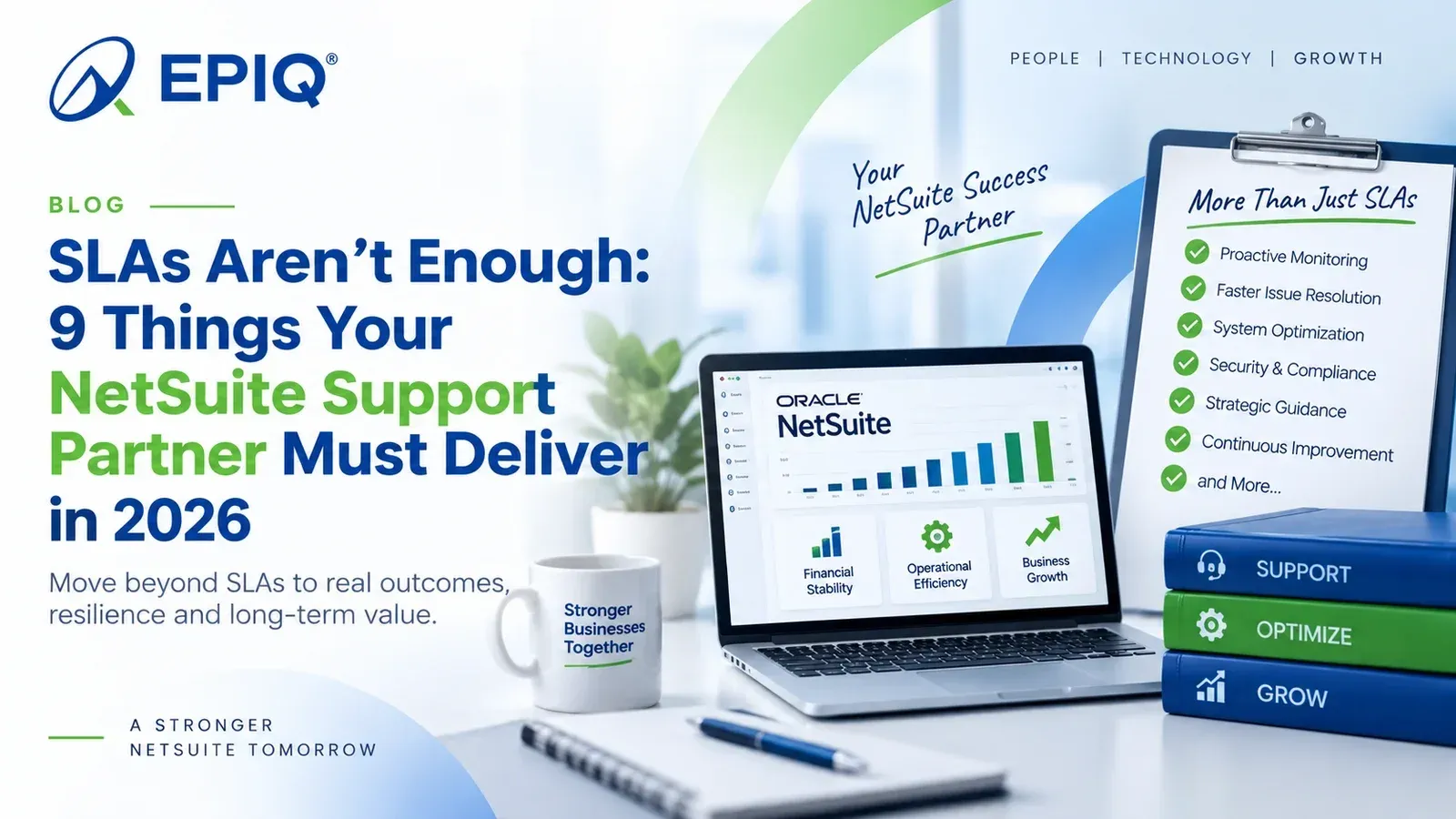
Your NetSuite support contract almost certainly has an SLA. It tells you how fast someone will respond and how fast they aim to resolve. What it does not tell you is whether your NetSuite environment is getting healthier, more reliable, more secure, and better optimized over time. A provider can hit every response target on paper and still leave you with recurring issues, fragile integrations, and a system that quietly gets harder to run. This article is about the difference, and the nine things a support partner should deliver in 2026 that no SLA clause captures.
The short version
- An SLA measures service behavior, such as response and resolution time. It does not measure whether your NetSuite environment is improving.
- A provider can meet its SLA while closing tickets without fixing root causes, ignoring integration health, or missing security and release risks.
- The right question is not "how fast will you respond," but "how well will you operate, protect, improve, and evolve our NetSuite environment."
- Use the 9-point framework below to evaluate a current or prospective partner. There is a printable checklist at the end.
Is an SLA enough to evaluate NetSuite support?
No. An SLA is necessary but not sufficient. It commits a provider to service behavior such as response time, resolution targets, availability, and escalation. It says nothing about whether that provider prevents recurring incidents, monitors your integrations, keeps up with NetSuite releases, manages security risk, or improves performance. A partner can meet its SLA and still deliver poor business outcomes.
SLAs matter. You should absolutely have one, and you should hold a provider to it. The mistake is treating the SLA as the whole evaluation. Speed of response is easy to measure and easy to promise, which is exactly why it dominates support conversations. The things that actually determine whether NetSuite runs well are harder to put in a clause, so they often go unmeasured and undelivered.
Consider what "meeting the SLA" can hide. A provider can respond within an hour, apply a quick fix, close the ticket, and hit every target, while the same issue returns next month because nobody investigated the cause. That is a green SLA report and a red business outcome.
The distinction that mattersSLA-focused support vs outcome-focused support
The clearest way to see the gap is to compare how the two approaches handle the same situations. One is measured by whether it responded. The other is measured by whether your NetSuite environment got better.
| Dimension | SLA-focused support | Outcome-focused support |
|---|---|---|
| Incidents | Responds within target and closes the ticket | Resolves the root cause so it does not recur |
| Monitoring | Waits for a user to report a problem | Detects issues before users feel them |
| Integrations | Troubleshoots after a sync fails | Monitors integration health continuously |
| Performance | Fixes a slowdown once reported | Spots performance risks early and tunes |
| Releases | Reacts when an upgrade breaks something | Tests each release in advance |
| Security | Handles access requests as they come | Reviews roles, access, and auth risk proactively |
| Documentation | Logs tickets | Builds institutional knowledge you own |
| Strategy | Resolves what you report | Advises on where NetSuite should go next |
Neither column is wrong to want. You need the left column as a floor and the right column as the actual value. The nine capabilities below are how you tell whether a partner delivers the right column.
Reviewing your current NetSuite support?
If your provider is hitting its SLA but the same problems keep coming back, that gap is worth a conversation. EPIQ can review how your environment is actually being supported.
Book a support review9 things your NetSuite support partner must deliver in 2026
This is the framework a CFO, CIO, or NetSuite administrator can use to evaluate a current or prospective partner. Each item is a distinct capability, with what good looks like, what weak looks like, and what to ask.
1Proactive monitoring and issue detection
What it is: Watching the environment for errors, failed jobs, and warning signs so problems are caught before users report them.
Good support: monitors scheduled scripts, integrations, and error logs, and opens a ticket itself when something fails, often before the business notices.
Weak support: waits for a user to complain, which means the clock only starts after the damage is already done.
2Root-cause analysis, not ticket closure
What it is: Investigating why an issue happened and fixing the cause, rather than applying a workaround and closing the ticket.
Good support: tracks recurring incidents, finds the underlying cause, and eliminates it, so ticket volume trends down over time.
Weak support: resolves the same symptom repeatedly. A fast average resolution time can actually hide this, because quick workarounds close tickets without solving anything.
3Integration health monitoring and end-to-end troubleshooting
What it is: Watching the connections between NetSuite and other systems, and being able to trace a problem across the whole data flow, not just inside NetSuite.
Good support: monitors integration jobs, catches sync failures early, and can troubleshoot across NetSuite, the middleware, and the connected application. This matters more every year as environments get more connected. Our guide to why NetSuite integrations fail covers the common failure points.
Weak support: only looks inside NetSuite, blames the other system, and leaves you to coordinate between vendors while records pile up unsynced.
4SuiteScript and customization expertise
What it is: The technical ability to read, fix, and safely change the custom scripts, workflows, and records your business runs on.
Good support: has developers who understand SuiteScript and SuiteFlow, can debug your customizations, and can tell you when custom code is the real cause of an issue. See our NetSuite customization services for the depth this requires.
Weak support: handles standard configuration only and stalls the moment a problem touches custom code, which in a mature account is most of the interesting problems.
5Performance optimization
What it is: Keeping NetSuite fast and within platform limits by tuning searches, scripts, and processes before they become a problem.
Good support: reviews slow saved searches, script governance usage, and heavy processes, and fixes them proactively. It treats a creeping slowdown as a warning, not a wait-and-see.
Weak support: only acts when users are already frustrated and month-end is already slow.
6Release and change management
What it is: Managing NetSuite's twice-yearly upgrades so new releases improve your account instead of breaking it.
Good support: reviews each release, tests your customizations and integrations in a Release Preview account before the upgrade reaches production, and tells you what will change for you specifically. With the 2026 releases driving the NetSuite Next rollout, this is more important than it has been in years. See our NetSuite 2026.2 release guide.
Weak support: finds out a release changed something when a user reports it broke.
7Security, access, and authentication readiness
What it is: Keeping roles, permissions, and login methods tight and current, and staying ahead of platform security changes.
Good support: reviews roles and access regularly, supports your audit and compliance needs, and plans for authentication changes ahead of time. A concrete 2026 example: Oracle has confirmed that from the 2027.1 release, older login methods for integrations retire in favor of OAuth 2.0, so a good partner is inventorying integrations now. Our TBA to OAuth 2.0 guide explains the timeline.
Weak support: treats security as access requests only, and will be scrambling when the authentication deadline arrives.
8Documentation and knowledge continuity
What it is: Recording what was changed and why, so knowledge lives with your business rather than in one person's head.
Good support: documents fixes, customizations, and configuration decisions, so a new team member or a different consultant can pick up where the last left off. This is your insurance against vendor lock-in.
Weak support: keeps the knowledge undocumented, which quietly makes you dependent on that one provider and puts you at risk if a key person leaves.
9Strategic optimization and continuous improvement
What it is: Helping the business use NetSuite better over time, not just keeping it running.
Good support: brings recommendations you did not ask for: a process to streamline, a feature to adopt, a way to prepare for AI capabilities like Ask Oracle and NetSuite Next. It behaves like a partner with a roadmap, not a queue. This is where optimization and consulting depth separate a true partner from a help desk.
Weak support: only ever responds to what you raise, and never tells you what you should be doing differently.
How does your provider score on these nine?
If you went down the list and hesitated on more than a couple, your support may be meeting its SLA while leaving real value on the table. EPIQ can benchmark your environment and support against this framework.
Request a NetSuite support assessmentWhat is the difference between NetSuite support and managed services?
NetSuite support typically resolves issues you report, against an SLA. NetSuite managed services is a broader, ongoing partnership that combines that reactive support with proactive monitoring, release management, optimization, and strategic guidance. In short, support answers tickets, while managed services takes responsibility for the health of the whole environment. Most of the nine capabilities above sit naturally in a managed model.
This is not a reason to always buy the bigger package. A stable account with a capable in-house admin may only need responsive support. The point is to match the model to your reality. If NetSuite is central to your operations, heavily customized, or tightly integrated, the reactive-only model tends to cost more in downtime and technical debt than it saves in fees. You can compare EPIQ's NetSuite support services and managed services to see where your needs fit, and our take on a NetSuite Advanced Customer Support alternative if you are weighing Oracle's own tiers.
Use thisThe NetSuite support partner checklist
Before you sign or renew a NetSuite support agreement, walk through this list with the provider. Anything you cannot get a clear, specific answer to is worth pressing on.
- Do they monitor the environment proactively, and can they prove it with an example?
- Do they investigate and eliminate recurring incidents, and can they show the trend?
- Do they have real SuiteScript and customization expertise on the team?
- Do they monitor integrations and troubleshoot end to end across systems?
- Do they review performance on a schedule, not just on complaint?
- Do they test each NetSuite release against your account before it goes live?
- Do they review roles and access, and have a plan for the 2027.1 authentication changes?
- Do they document changes, and do you own that documentation?
- Do they bring proactive recommendations and a roadmap, not just answers?
- Does the SLA sit on top of all of the above, rather than standing in for it?
Want this checklist run against your environment?
EPIQ can assess your NetSuite account and your current support against all nine points, then show you exactly where the gaps are and what they are costing you.
Talk to EPIQ's NetSuite teamWhat businesses should look for in 2026
An SLA measures a slice of service performance. It does not measure the value of a NetSuite support relationship. The providers worth keeping are the ones who are all of the following at once: responsive when you need them, proactive before you need them, technically deep enough to handle your customizations and integrations, preventative rather than repetitive, and strategic about where your NetSuite environment should go.
Keep the SLA. Hold your provider to it. Then look past it, and ask whether your environment is genuinely healthier, more secure, and better optimized than it was a year ago. If the honest answer is no, the SLA was never the problem, and a better SLA will not be the fix.
FAQFrequently asked questions
What should a NetSuite support partner provide?
Beyond meeting an SLA, a NetSuite support partner should provide proactive monitoring, root-cause resolution, integration monitoring, SuiteScript and customization expertise, performance optimization, release and change management, security and access reviews, clear documentation, and strategic recommendations. The SLA sets the service floor; these capabilities determine the value.
What should a NetSuite support SLA include?
A NetSuite support SLA should define response times by priority, resolution targets or expectations, availability, escalation paths, and communication commitments. Treat these as the minimum. They describe how a provider behaves, not whether it prevents recurring issues or improves your environment.
What is proactive NetSuite support?
Proactive NetSuite support means detecting and preventing problems before users report them: monitoring scripts and integrations, testing releases in advance, reviewing performance and security on a schedule, and recommending improvements. It is the opposite of waiting for a ticket, and it is where most of the real value sits.
How do I evaluate a NetSuite support partner?
Evaluate a NetSuite support partner on capability, not just response speed. Use the nine-point framework above, ask for concrete examples of issues they caught proactively and root causes they eliminated, confirm they can support your customizations and integrations, and check how they handle releases, security, and documentation.
Should NetSuite support include integration monitoring?
Yes. As NetSuite environments connect to more systems, integration failures become a leading cause of data problems. A capable partner monitors integration health continuously and can troubleshoot across NetSuite, the middleware, and the connected application, rather than only reacting after a sync fails.
When should a company switch NetSuite support providers?
Consider switching when issues recur despite being closed, when your provider cannot support customizations or integrations, when releases keep breaking things, when there is no proactive monitoring or documentation, or when you never receive strategic guidance. A provider meeting its SLA while these persist is a common reason businesses change partners.
Can a NetSuite support partner help with customizations?
A strong one can. Supporting a real-world account means debugging and safely changing SuiteScript, workflows, and custom records, not just standard configuration. If a provider cannot work with your customizations, it cannot resolve most of the issues a mature NetSuite account actually produces.
Rethinking your NetSuite support in 2026?
Whether you are switching providers, moving from internal-only support, or just want a second opinion, EPIQ Infotech supports NetSuite environments with the depth this article describes. Tell us where it hurts and we will show you what better looks like.
Get in touch with EPIQRelated NetSuite resources from EPIQ
Note: NetSuite platform details referenced here, including the twice-yearly release cadence, the NetSuite Next rollout, and the authentication changes planned for the 2027.1 release, are set by Oracle and can change. Confirm current specifics in your official NetSuite release notes. This article is practical guidance from EPIQ Infotech based on hands-on NetSuite support and consulting experience, and is not a substitute for Oracle's documentation.

Santosh Krishnamoorthy is a Principal ERP Consultant at EPIQ Infotech, with extensive experience in NetSuite and enterprise systems. He works with finance and operations teams to improve reporting accuracy, streamline workflows, and build ERP environments that support sustainable growth. His writing focuses on practical insights drawn from real implementation and support experience.
Free Consultation
Talk to a NetSuite Expert
Response within 1 hour