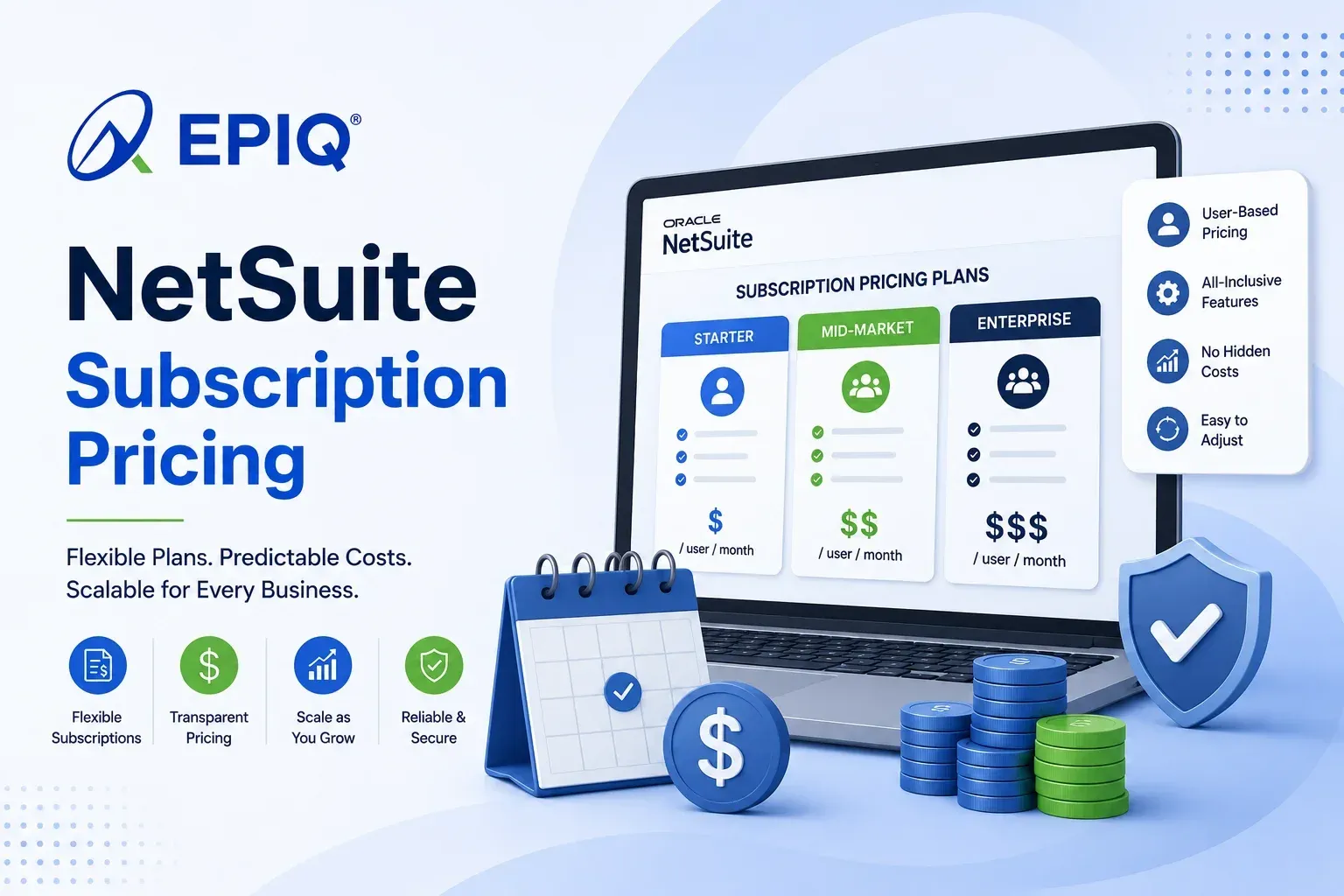
NetSuite Subscription Pricing (2026): Model, Terms & Renewals
Updated 2026 Written by Santosh Krishnamoorthy, Principal ERP Consultant · Reviewed by the EPIQ Infotech NetSuite Practice Team against live quotes and renewals · 8 min read
NetSuite is sold only as an annual cloud subscription, never a one-time or perpetual purchase.
Your subscription is assembled from a base platform license, per-user seats and the modules you switch on, billed annually and usually committed for one to five years. The number that decides a good deal from an expensive one is not year one; it is the renewal. Without a negotiated uplift cap, renewal increases commonly run 5 to 15% and have been reported as high as 15 to 50%. Oracle publishes no list price, so treat figures here as industry-estimate planning ranges.
Key takeaways
- There is no perpetual option. You license ongoing access, hosting, two upgrades a year and support, and the cost never goes to zero.
- The subscription is modular and recurring. Adding a module or a batch of seats changes your annual bill, not just a one-time fee.
- Multi-year terms lower the rate (roughly 15 to 25% at three years, up to about 30% at five) but reduce your freedom to drop seats or modules mid-term.
- Renewals are where budgets break. A fixed uplift cap of 3 to 5%, secured in writing at signing, is the single most valuable clause in the contract.
- Contracts auto-renew. Give notice inside the window, often 60 to 90 days before the renewal date, or you can be locked into another term at revised pricing.
- Year two is not year one. Once implementation drops off, ongoing spend is often 60 to 70% of the first-year total, then rises with each renewal uplift.
In this guide
NetSuite is not bought once; it is subscribed to annually. Understanding the model, the contract term and the renewal mechanics is what separates a good deal from an expensive one two years later. This guide covers how the subscription works and, more importantly, how to keep control of it across the full term. For the total budget picture see the NetSuite pricing hub.
1. What is the NetSuite subscription model?
Definition: NetSuite subscription pricing
NetSuite subscription pricing is an annual, cloud-based licensing model in which you pay recurring fees for continued access rather than a one-time purchase. The subscription is assembled from a base platform license, per-user seats and the modules you switch on, billed annually, with automatic upgrades twice a year. There is no perpetual license.
You never own the application; you license ongoing access, hosting, updates and support. Your price is assembled from base platform, user seats and modules, and it moves as your configuration changes. With more than 37,000 organisations running on NetSuite, this SaaS model is the norm rather than the exception, but the recurring, modular structure is exactly why costs can drift upward if you do not manage the contract.
2. Subscription vs perpetual licensing
Legacy ERP was often a perpetual license: a large up-front payment plus annual maintenance. NetSuite is the opposite. The upside is no server infrastructure and automatic upgrades; the trade-off is that the cost never goes to zero, so you must model total cost of ownership over the full term rather than a single purchase price.
| Perpetual (legacy) | NetSuite subscription | |
|---|---|---|
| Payment | Large up-front plus maintenance | Annual subscription |
| Ownership | License owned | Right to access |
| Upgrades | Paid or manual | Included, twice yearly |
| Infrastructure | You host | Oracle hosts |
| Cost over time | Falls after payback | Recurring, rises at renewal |
A perpetual purchase is a transaction. A subscription is a relationship, so negotiate the whole relationship, not just year one.
3. How the subscription is assembled
Your subscription equals the base platform license, plus per-user seats, plus the modules you activate, all billed annually. That modularity makes NetSuite scalable, but it also means adding a module or a batch of users changes your recurring cost, not a one-time fee. For the components in detail, see the license cost and module pricing guides, or the full cost breakdown.
4. What the subscription includes
Unlike a perpetual license where upgrades and hosting are separate projects, the NetSuite subscription bundles several things into the annual fee:
- Hosting and infrastructure. Oracle runs the environment; there are no servers for you to buy or patch.
- Two feature upgrades a year. Every account moves to the latest release on Oracle's schedule, so you are never on unsupported versions.
- Basic support. Web-case support and the knowledge base are included; premium and Advanced Customer Support tiers cost extra. See EPIQ's alternative to Advanced Customer Support.
- Embedded 2026 AI. The current release bundles AI capabilities into the platform with no separate AI line item for most editions.
5. Contract term and billing
NetSuite subscriptions are annual commitments, usually signed for multiple years and billed annually up front. Longer terms secure better rates and price protection but reduce your flexibility to reduce seats or modules.
| Term | Typical rate benefit | Trade-off |
|---|---|---|
| 1 year | List-adjacent | Maximum flexibility, higher per-unit rate, uncapped renewal risk |
| 3 years | ~15 to 25% below annual | Better rate and price protection, less freedom to reduce |
| 5 years | Up to ~30% below annual | Best rate, lowest flexibility, longest commitment |
6. Renewals and price uplift
This is what buyers most often miss. Unless you negotiate a cap, renewal pricing can rise sharply, and the discount that made year one attractive can quietly disappear. Uncapped uplifts commonly run 5 to 15% and have been reported as high as 15 to 50% in some contracts. The 2025 full-user rate increase (roughly $99 to $129 per user per month, about 30%) reached most existing customers at renewal, not at signing.
Renewal caps, price protection and module bundling are far easier to win in the initial deal than at renewal, when your switching cost is highest. The mechanics of adding and reducing seats across the term are covered in the license cost guide.
7. Multi-year cost trajectory: why the cap matters
A renewal cap sounds like a detail until you model it. Take a company whose year-one license is $100,000. Here is how the annual license evolves over five years under an uncapped renewal at 10% per year versus a capped renewal at 3% per year.
| Year | Uncapped (10% / yr) | Capped (3% / yr) | Annual difference |
|---|---|---|---|
| Year 1 | $100,000 | $100,000 | $0 |
| Year 2 | $110,000 | $103,000 | $7,000 |
| Year 3 | $121,000 | $106,090 | $14,910 |
| Year 4 | $133,100 | $109,273 | $23,827 |
| Year 5 | $146,410 | $112,551 | $33,859 |
| 5-year total | $610,510 | $530,914 | ~$79,600 |
Same starting price, the same product, a difference of roughly $80,000 over five years, decided entirely by one clause negotiated at signing. This is why total cost of ownership on a subscription must be modelled across the term, not read off the year-one invoice.
8. How SuiteSuccess packages the subscription
SuiteSuccess bundles pre-built roles, dashboards and workflows for your industry into the subscription, which can shorten implementation and reduce configuration cost. It often reframes the buying question from "which modules do I add?" to "which industry edition fits?" That can be efficient when the bundle matches how you operate, and wasteful when it does not, so evaluate it as a pricing structure rather than a feature checklist.
9. Structuring a smart subscription
- Right-size seats first. Do not pay for unused access every year; see the license cost guide.
- Start with the modules you need now. Add the rest as you grow, since modules are easy to add and hard to remove before renewal.
- Negotiate the renewal cap and price protection in the first contract, not at renewal.
- Model total cost of ownership across the full term, including the renewal trajectory above, not just year one.
- Diarise the renewal notice window (60 to 90 days out) so auto-renewal never decides for you.
- Have a partner review the terms. EPIQ's consulting team does exactly this.
Reviewing a NetSuite quote or renewal?
Before you sign, have EPIQ Infotech model the full-term cost and flag the clauses that matter: renewal caps, seat mix and module bundling. We are a certified Oracle NetSuite Alliance Partner.
Talk to a NetSuite Pricing Expert Get a contract reviewFrequently asked questions
Is NetSuite a subscription or a one-time purchase?
NetSuite is an annual cloud subscription, not a one-time or perpetual purchase. You pay every year for continued access, hosting, updates and support.
How does the NetSuite pricing model work?
It is a subscription-plus-modular model: a base platform license, per-user seats and add-on modules, billed annually. Your price changes as your configuration changes.
Does NetSuite pricing go up at renewal?
It can. Unless you negotiate a renewal uplift cap at signing, the introductory discount may not carry forward. Uncapped increases commonly run 5 to 15% and have been reported higher. A fixed cap, commonly 3 to 5%, is the most valuable protection you can get.
What contract term should I choose for NetSuite?
Shorter terms maximise flexibility; multi-year terms of three to five years secure better rates and price protection, roughly 15 to 25% at three years and up to about 30% at five. The right choice depends on confidence in your growth and module roadmap.
Can you buy NetSuite with a perpetual license?
No. NetSuite is cloud-only and sold as an annual subscription; there is no perpetual, own-forever license option.
Does the NetSuite subscription auto-renew?
Yes. NetSuite agreements typically renew automatically unless you give notice inside a defined window, often 60 to 90 days before the renewal date. Miss it and you can be locked into another term at revised pricing.
Is the NetSuite subscription billed monthly or annually?
NetSuite is billed annually, typically up front, even though prices are often quoted per user per month. There is no true monthly, cancel-anytime plan.
What is included in the NetSuite subscription fee?
The annual fee covers access to your licensed platform and modules, Oracle hosting, two feature upgrades a year and basic web-case support. Premium support and Advanced Customer Support are priced separately.
Santosh Krishnamoorthy
Principal ERP Consultant at EPIQ Infotech, with extensive experience in NetSuite and enterprise systems. He works with finance and operations teams to structure and renew NetSuite contracts, streamline workflows and build ERP environments that support sustainable growth. This guide is maintained by EPIQ consultants who scope, implement and support NetSuite for mid-market and enterprise clients; ranges are reviewed against live quotes and renewals.
Sources and references
- Oracle NetSuite, official pricing enquiry: netsuite.com pricing
- Oracle NetSuite, company information: netsuite.com company information
- G2, verified NetSuite reviews: g2.com/products/netsuite
- Gartner Peer Insights, midmarket ERP: gartner.com reviews
Figures throughout are industry-estimate ranges for planning purposes. Oracle does not publish an official NetSuite price list; every quote and renewal is configured and negotiated, so treat these as planning ranges, not quotes. Ranges are reviewed by the EPIQ NetSuite Practice Team against live client quotes and renewals.
Continue in the NetSuite Pricing series

Santosh Krishnamoorthy is a Principal ERP Consultant at EPIQ Infotech, with extensive experience in NetSuite and enterprise systems. He works with finance and operations teams to improve reporting accuracy, streamline workflows, and build ERP environments that support sustainable growth. His writing focuses on practical insights drawn from real implementation and support experience.
Free Consultation
Talk to a NetSuite Expert
Response within 1 hour