NetSuite Alliance Partners: What They Are, How the Program Works, and How to Choose One
A plain-language guide to Oracle NetSuite's Alliance Partner program: who sells you the license, who implements it, how Oracle ranks partners, and the questions that separate a good fit from a good sales pitch.
The short answer
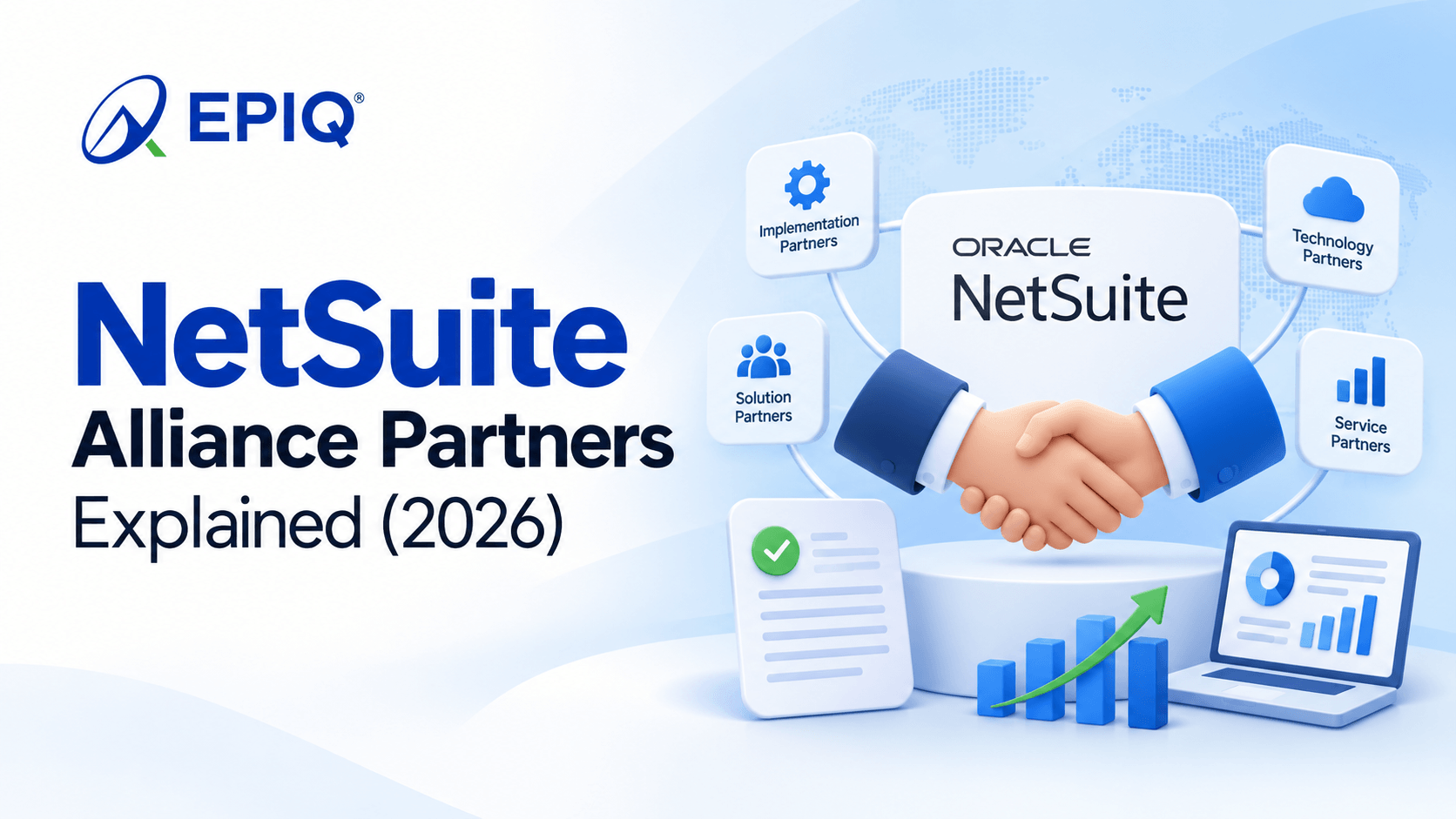
A NetSuite Alliance Partner is a consulting and implementation firm in Oracle NetSuite's Alliance Partner program. Alliance Partners do not resell NetSuite licenses. You license NetSuite directly from Oracle, and the Alliance Partner delivers the professional services: implementation, integration, customization, training, and ongoing optimization. According to Oracle, Alliance Partners perform about 40% of NetSuite implementations.
Key takeaways
- With an Alliance Partner you hold two agreements: a subscription with Oracle and a services contract with the partner.
- Solution Providers, by contrast, sell the license and deliver services under one relationship.
- Oracle tiers Alliance Partners with an assessment score based on certifications, consultant headcount, customer satisfaction, and commitment.
- Tier signals investment in NetSuite, not fit for your project. Industry references and the named delivery team matter more.
- You can confirm a firm's partner type in Oracle's official NetSuite Partner Finder before you sign anything.
What is a NetSuite Alliance Partner?
Oracle NetSuite reaches customers through several partner programs, and the Alliance Partner program is the one built around professional services. Oracle describes Alliance Partners as firms that provide business transformation consulting along with implementation and integration services, and it supports them with certified training, tools, and resources so they can specialize in particular business functions, product areas, and industries.
The defining feature is commercial, not technical. An Alliance Partner is not in the business of reselling NetSuite subscriptions. Your company evaluates and licenses NetSuite through Oracle's own sales team, and you engage the Alliance Partner separately to design, configure, and support the system. The partner works alongside Oracle's account team throughout, but the two roles stay distinct.
In practice, that means an Alliance Partner is judged almost entirely on delivery quality. It earns its place in Oracle's ecosystem through certified consultants, successful go-lives, and satisfied customers rather than license volume. That is also why Oracle often brings an Alliance Partner into a deal when a prospect buys direct but needs implementation help.
Where Alliance Partners fit among NetSuite partner types
Most confusion about NetSuite partners comes from the fact that "NetSuite partner" covers several different programs. Each one defines who sells the license, who delivers services, and who you call when something breaks. The table below summarizes the main programs listed on Oracle NetSuite's partner pages.
| Program | Sells the NetSuite license? | Primary role | Typical fit |
|---|---|---|---|
| Alliance Partner | No. You license from Oracle. | Consulting, implementation, integration, customization, training, optimization | Companies that want a direct contract with Oracle plus a specialist services firm |
| Solution Provider | Yes, in coordination with Oracle | License sales plus implementation and support under one relationship | Buyers who prefer a single point of contact for licensing and services |
| BPO Partner | Varies by arrangement | Outsourced business processes (for example accounting) run on NetSuite | Companies outsourcing finance or back-office operations |
| Referral Partner | No. Refers prospects for a fee. | Introductions, sometimes followed by services on the customer's account | Advisors and consultants who recommend NetSuite to clients |
| SuiteCloud Developer Network (SDN) | No | Builds SuiteApps and extensions on the SuiteCloud platform | Companies needing a specific add-on capability rather than a full implementation |
| Accountant Program | No | Lets accounting firms access and support clients already running NetSuite | CPA firms serving NetSuite customers |
Some firms take part in more than one program, so the label on a website is less important than the relationship that applies to your specific deal. Ask any prospective partner which program governs your contract, and confirm it in writing.
How an Alliance Partner engagement works
The easiest way to understand the Alliance model is to look at who signs what. There are three relationships in play, and only two of them involve you directly.
Here is how a typical engagement moves from evaluation to steady state.
-
Evaluation with Oracle's sales team
Oracle NetSuite's account team leads demos, scoping of modules and user counts, and the commercial proposal. An Alliance Partner may join early to validate fit for your industry or processes.
-
Partner selection
Oracle may recommend Alliance Partners based on your industry, region, and requirements, or you can bring your own. This is the point to run a structured evaluation instead of accepting the first name offered.
-
Two contracts
You sign the NetSuite subscription with Oracle and a statement of work with the Alliance Partner. License pricing is negotiated with Oracle; services pricing, scope, and change control are negotiated with the partner. Our guides to NetSuite license cost and implementation cost break down each side.
-
Implementation
The partner leads design, configuration, data migration, integrations, testing, training, and cutover. Depending on scope, that may follow Oracle's SuiteSuccess methodology or a phased, requirements-led approach.
-
Post-go-live support and optimization
Oracle continues to provide platform support under your subscription. The Alliance Partner typically handles functional support, enhancements, new modules, and release readiness under a separate support agreement.
Weighing whether you need a partner at all? We compare the two routes in detail in NetSuite Direct vs. Partner Implementation.
How Oracle tiers and ranks Alliance Partners
Not every Alliance Partner holds the same standing with Oracle. According to Oracle NetSuite's program pages, Alliance Partners are tiered using an assessment scoring system that reflects their total contribution and commitment to NetSuite. The highest tiers require certifications across multiple products, a meaningful number of implementation consultants, strong customer satisfaction, and a sustained commitment to delivering complete solutions for joint customers.
Oracle also ranks partners by their strength in particular industries, verticals, and horizontal offerings, and uses those rankings to decide which partners to prioritize in sales engagements within each region. Partners that bring repeatable offerings, accelerators, and their own intellectual property tend to lead the segments they compete in.
For buyers, the takeaway is simple. A higher tier tells you a partner has invested heavily in NetSuite and meets Oracle's quality thresholds. It does not tell you whether that partner has delivered a project like yours, or whether its senior people will be on your account. Treat tier as a qualifying filter, then evaluate fit separately.
What Alliance Partners actually deliver
Oracle positions Alliance Partners across most of the NetSuite product family. Its Alliance program page lists partner services for ERP, CRM, Planning and Budgeting, Ecommerce, Human Capital Management, Professional Services Automation, Configure Price Quote, NetSuite Analytics Warehouse, and Field Service Management. Beyond products, Oracle notes that partners help with advisory, consulting, integrations, customizations, training, support, optimization, and staffing.
In a typical engagement, that translates into the following work:
- Process design. Mapping order-to-cash, procure-to-pay, record-to-report, and industry-specific flows into NetSuite before any configuration starts.
- Configuration and customization. Roles, forms, workflows, saved searches, and SuiteScript where configuration alone falls short.
- Data migration. Cleansing, mapping, and loading master data and open transactions from QuickBooks, Sage, legacy ERPs, or spreadsheets.
- Integrations. Connecting NetSuite to CRM, ecommerce, banking, tax, payroll, and warehouse systems. See our NetSuite integration services for common patterns.
- Training and adoption. Role-based training so finance, operations, and sales teams can work in the system on day one.
- Ongoing optimization. Health checks, twice-yearly release readiness, and new module rollouts as the business grows. Many companies use a partner as an alternative to Oracle's Advanced Customer Support.
Oracle reports that Alliance Partners perform 40% of NetSuite implementations and links that experience to faster return on value for new and existing customers. Many Alliance Partners also build vertical solutions that extend NetSuite for specific industries.
Alliance Partner vs. Solution Provider: which model fits?
Both models can produce an excellent implementation. The difference lies in how the commercial relationship is structured and where accountability sits.
| Consideration | Alliance Partner | Solution Provider |
|---|---|---|
| License contract | Directly with Oracle NetSuite | Through the partner |
| Services contract | Separate statement of work with the partner | Bundled with the license relationship |
| Commercial negotiation | Two negotiations: Oracle for licenses, partner for services | One negotiation with the partner |
| Relationship with Oracle | Direct account relationship | Mediated mostly through the partner |
| Changing services firms later | Simpler, because the license stays with you and Oracle | Possible, but licensing and services are intertwined |
| Best suited to | Companies wanting direct vendor access with specialist delivery | Companies wanting one accountable party end to end |
Choose the Alliance route when you value a direct contract with Oracle, expect to work with Oracle's account team over the long term, or want the flexibility to change services firms without touching your subscription. Choose a Solution Provider when a single point of accountability for licensing and delivery matters more to you. If you lean that way, our guide on choosing the right NetSuite Solution Provider covers that evaluation.
Types of firms in the Alliance network
The Alliance program covers a wide range of firm sizes and business models. Knowing which category a firm belongs to helps you shortlist faster than any ranking article.
Global systems integrators
Oracle's partner pages list global systems integrators such as Accenture, Capgemini, Cognizant, Deloitte, HCL, Infosys, Tata Consultancy Services, Tech Mahindra, and Wipro. These firms suit large, multinational programs where NetSuite sits inside a broader finance or technology transformation, often alongside other enterprise platforms.
Regional systems integrators and advisory firms
Accounting, advisory, and regional consulting firms run NetSuite practices alongside audit, tax, or management consulting. They fit companies whose ERP decision is tightly linked to finance transformation, compliance, or a transaction such as an acquisition.
Specialist NetSuite firms
Focused NetSuite consultancies concentrate their certified teams on the platform, often with depth in a few industries or in integration-heavy projects. They typically fit mid-market companies that want senior practitioners on the project and continuity from implementation into long-term support.
No category is universally better. A multinational with fifteen subsidiaries and a mid-market distributor with one warehouse need very different partners. For a broader look at the whole partner market, including non-Alliance firms, see our complete guide to NetSuite partners.
How to find and verify a NetSuite Alliance Partner
Partner status is easy to claim on a website and easy to check. Before you invest time in demos and proposals, confirm the basics.
- Check Oracle's directory. Search the official NetSuite Partner Finder and confirm the firm appears with the partner type it claims.
- Ask for named certifications. Request the NetSuite certifications held by the people proposed for your project, such as SuiteFoundation, Administrator, ERP Consultant, or SuiteCloud Developer. Firm-wide totals say little about your team.
- Ask Oracle's account team. If you are evaluating NetSuite through Oracle directly, your account executive can confirm a firm's program status and its track record in your industry.
- Call references in your industry. Speak to at least two customers of similar size and complexity, ideally one that went live within the last two years.
- Review the support model in writing. Confirm response times, escalation paths to Oracle, and who handles twice-yearly NetSuite releases after go-live.
Questions to ask an Alliance Partner before you sign
A structured set of questions makes proposals comparable and exposes gaps early. These are the ones that matter most in an Alliance engagement.
| Question | Why it matters | A strong answer includes |
|---|---|---|
| Who will be on our project, by name? | Firm reputation and team quality are not the same thing | Named leads, their certifications, and comparable projects they delivered |
| How do you coordinate with Oracle's account and support teams? | You hold the license with Oracle, so handoffs must be clear | A defined escalation path for platform issues versus configuration issues |
| Which methodology fits our scope, and why? | SuiteSuccess and requirements-led approaches suit different situations | A recommendation tied to your processes, not a default |
| How do you price scope changes? | Change orders drive most budget overruns | A written change control process with approval thresholds |
| What happens after go-live? | Most issues surface in the first three to six months | A hypercare period plus a defined support and optimization plan |
| Can we speak to customers in our industry? | Industry fit predicts how many processes you will need to customize | References of similar size and complexity, offered without hesitation |
Red flags to watch for
If you are already live and see signs that your implementation is underperforming, a NetSuite health check is a low-risk way to get an independent view before changing partners.
Where EPIQ Infotech fits
EPIQ Infotech has been a certified Oracle NetSuite Alliance Partner since 2013. Our team has delivered 100+ NetSuite projects for clients in 24 countries, maintains a 96% client retention rate, and brings more than 15 years of Oracle ERP experience to implementation, integration, customization, and long-term support. As an Alliance Partner, we work alongside your Oracle account team while you keep your subscription directly with Oracle.
If you are shortlisting firms, you can review our NetSuite Alliance Partner services in the USA, including industries served, delivery approach, and how we structure post-go-live support.
Frequently asked questions about NetSuite Alliance Partners
Do NetSuite Alliance Partners sell NetSuite licenses?
No. Under the Alliance model, your company licenses NetSuite directly from Oracle NetSuite. The Alliance Partner provides professional services such as implementation, integration, customization, training, and support under a separate statement of work.
What is the difference between a NetSuite Alliance Partner and a Solution Provider?
A Solution Provider sells NetSuite licenses in coordination with Oracle and delivers implementation and support under one relationship. An Alliance Partner focuses on services only, so you hold the license contract with Oracle and a separate services contract with the partner.
Who supports my NetSuite account if I use an Alliance Partner?
Oracle continues to provide platform support under your NetSuite subscription. The Alliance Partner typically handles functional support, configuration changes, enhancements, and release readiness under its own support agreement. Agree on the escalation path between the two before go-live.
How does Oracle tier NetSuite Alliance Partners?
Oracle uses an assessment scoring system based on each partner's contribution and commitment to NetSuite. Higher tiers require certifications across multiple products, more implementation consultants, strong customer satisfaction, and consistent delivery quality. Oracle also ranks partners by industry and vertical strengths.
What share of NetSuite implementations do Alliance Partners deliver?
Oracle NetSuite states that Alliance Partners perform 40% of NetSuite implementations, which it associates with faster return on value for new and existing customers.
How can I verify that a firm is a NetSuite Alliance Partner?
Search for the firm in Oracle's official NetSuite Partner Finder and check the partner type shown. You can also ask your Oracle account executive to confirm the firm's program status, and request the individual NetSuite certifications of the consultants proposed for your project.
Can I switch to a different Alliance Partner after go-live?
Yes. Because your NetSuite subscription is held directly with Oracle, you can engage a different Alliance Partner for support or optimization without changing your license agreement. Plan a structured handover that covers documentation, customizations, integrations, and open issues.
Does a higher Alliance Partner tier mean a better fit for my project?
Not necessarily. Tier reflects a partner's overall investment in NetSuite and its standing with Oracle. Fit depends on industry experience, the named delivery team, methodology, and the post-go-live support model. Use tier to qualify partners, then evaluate fit separately.
Related reading
- NetSuite Direct vs. Partner Implementation
- How to Choose the Right NetSuite Solution Provider
- NetSuite Implementation Cost (2026)
- NetSuite License Cost (2026)
- What Is SuiteSuccess?
- NetSuite ACS Alternatives
Sources: Oracle NetSuite Alliance Partner Program, Oracle NetSuite Partner Program overview, and Oracle NetSuite Partner Finder.

Santosh Krishnamoorthy is a Principal ERP Consultant at EPIQ Infotech, with extensive experience in NetSuite and enterprise systems. He works with finance and operations teams to improve reporting accuracy, streamline workflows, and build ERP environments that support sustainable growth. His writing focuses on practical insights drawn from real implementation and support experience.
Free Consultation
Talk to a NetSuite Expert
Response within 1 hour