NetSuite Cost Breakdown: Every Line Item, Explained (2026)
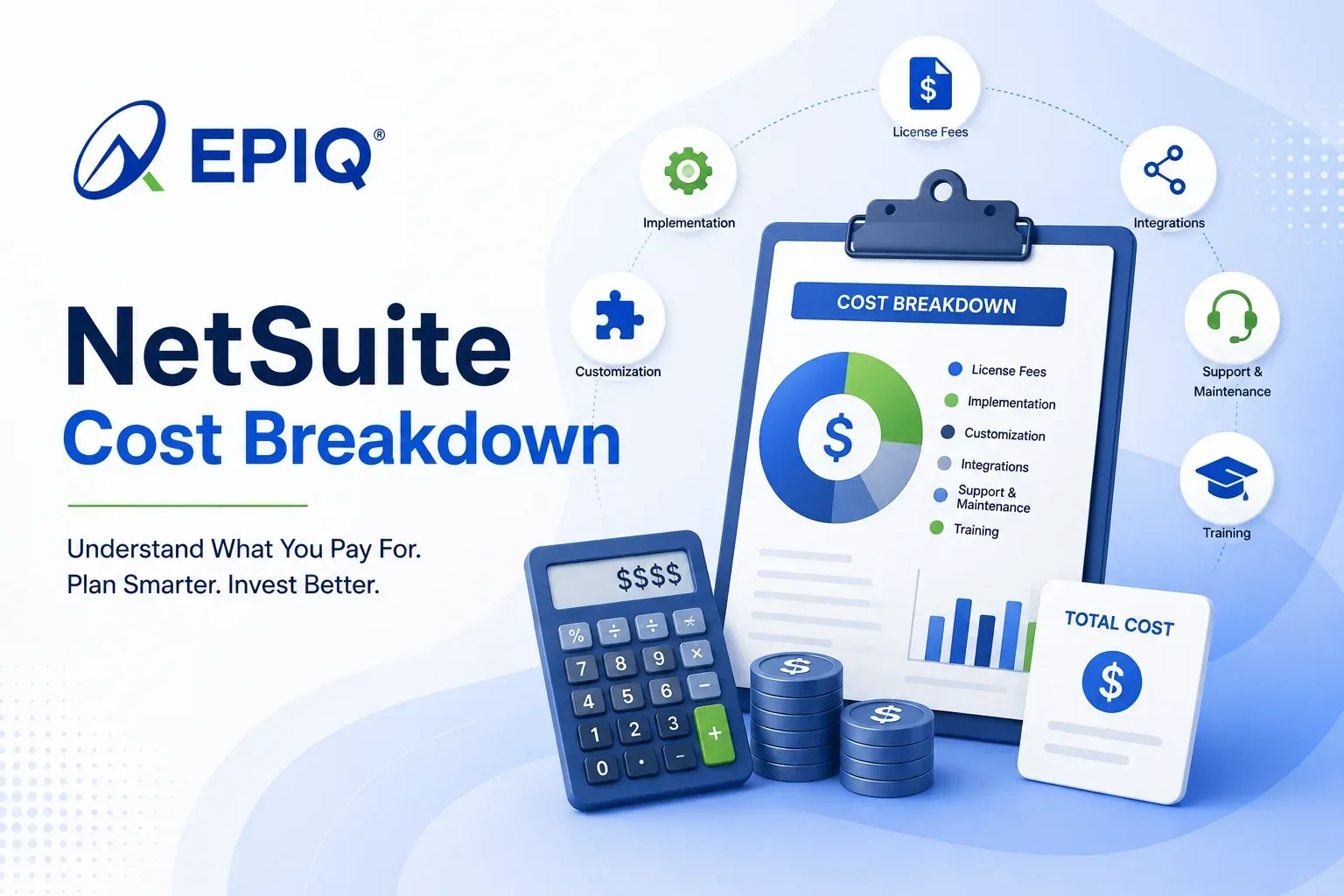
NetSuite pricing looks opaque because it's quoted as one number. It isn't one number — it's seven line items stacked together. This breakdown shows each one, the ranges to expect, and a formula to build your own estimate.
NetSuite cost is built from seven components: base platform license ($9XX–$5,XXX/mo), user licenses ($9X–$1XX/user/mo full; $1X–$5X light), modules ($5,XXX–$3X,XXX+/yr), one-time implementation ($2X,XXX–$1XX,XXX+), integrations, customisation, and ongoing support (~15–30% of license). Add them over three years for true total cost of ownership.
Jump to
1. NetSuite cost breakdown at a glance
| # | Component | Type | Typical range |
|---|---|---|---|
| 1 | Base platform license | Recurring | $9XX–$5,XXX / mo |
| 2 | User licenses | Recurring | $9X–$1XX / user / mo (full) |
| 3 | Modules | Recurring | $5,XXX–$3X,XXX+ / yr |
| 4 | Implementation | One-time | $2X,XXX–$1XX,XXX+ |
| 5 | Integrations | One-time + recurring | $2XX–$1,XXX / mo per connector |
| 6 | Customisation | One-time | $1X,XXX–$5X,XXX+ |
| 7 | Support | Recurring | ~15–30% of annual license |
Figures throughout are industry-estimate ranges for a global audience. Oracle does not publish an official NetSuite price list — every quote is configured and negotiated, so treat these as planning ranges, not quotes.
2. Base platform license
The base license is your fixed entry cost for core NetSuite — financials, general ledger and order management — and runs about $9XX–$5,XXX/month depending on edition. It's the same regardless of how many people log in.
The tier you land on depends on your edition, which is driven by business complexity: number of legal entities, currencies and transaction volume. Single-entity companies start at the low end; multi-entity operations start higher because they need a more capable edition.
3. User licenses
Full user licenses cost about $9X–$1XX per user per month; lighter employee and self-service seats run $1X–$5X. Seat mix — the ratio of full to light seats — is the most controllable lever in the whole budget.
A common, expensive mistake is buying full seats for staff who only submit expenses or approve requests. Match every person to the lightest seat that covers their role. Our dedicated NetSuite license cost guide covers seat types and right-sizing in depth.
4. Modules & SuiteApps
Add-on modules typically add $5,XXX–$3X,XXX+ per year combined. Each module — advanced financials, inventory, warehouse management, manufacturing, subscription billing, projects, commerce — carries its own recurring fee on top of the base license.
| Module | Adds | Indicative cost |
|---|---|---|
| Advanced Financials | Budgeting, allocations, statistical accounts | ~$5XX–$1,XXX / mo |
| Advanced / demand-based Inventory | Multi-location, lot & demand planning | ~$5XX / mo |
| Warehouse Management (WMS) | RF scanning, wave picking, zones | ~$1,XXX–$2,XXX / mo |
| Manufacturing | Work orders, routing, WIP | ~$6XX–$2,XXX / mo |
| SuiteBilling / Rev Rec | Subscription billing, ASC 606 revenue | Module add-on |
| SuiteCommerce (Std / Adv) | B2B/B2C storefront | ~$2,XXX / ~$5,XXX / mo |
Full detail and editions are in NetSuite module & edition pricing.
5. Implementation
Implementation is a one-time project costing $2X,XXX–$1XX,XXX+, a useful rule of thumb being 1–2× your annual license fee. It covers configuration, data migration, integration, testing, training and go-live.
It is the largest single variable and the most commonly underestimated. Lean single-entity rollouts sit at the low end; multi-entity, heavily customised programmes reach the high end. See EPIQ's implementation cost guide and implementation services.
6. Integrations
Integrations to systems like e-commerce, CRM or 3PLs add cost two ways: build effort up front, and recurring connector fees of roughly $2XX–$1,XXX/month each. Native APIs are included, but developer time is not free.
Pre-built connectors suit standard platforms; custom APIs suit unique flows. Budget more than you expect — integration scope reliably expands during a project.
7. Customisation
Point-and-click configuration (custom fields, forms, saved searches, basic workflows) is included. Scripted customisation for logic that can't be configured typically runs $1X,XXX–$5X,XXX+ depending on scope.
Be rigorous about what genuinely needs custom development versus what configuration already handles — over-customisation creates ongoing maintenance every release cycle.
8. Support & optimisation
Basic support is included; a formal premium or managed tier typically costs 15–30% of your annual license. Many companies get faster, more configuration-aware help from a partner than from a generic support tier.
See EPIQ's managed services, support services and the alternative to Advanced Customer Support.
9. Service tiers
Separate from edition and modules, your account is assigned a service tier that sets infrastructure capacity — concurrent users, file storage and monthly transaction volume. As you scale, moving up a tier is the fix for slow performance or storage limits, and it carries a price increase.
| Tier | Scales for |
|---|---|
| Standard | Most small & growing companies |
| Premium | Higher concurrency, storage & transaction volume; often includes a sandbox |
| Enterprise / Ultimate | Large-scale, high-volume global operations |
Service-tier capacity and pricing are set by Oracle and negotiated per contract. Confirm your tier limits before signing.
10. Hidden costs buyers miss
- Sandbox environments for safe testing — included on some tiers, extra on others.
- Data migration overruns when legacy data is messy.
- Custom script maintenance — budget ~10–15% of build cost per year.
- Integration sprawl — each connector adds a monthly fee.
- Over-licensing full users — the biggest avoidable waste; audit seats yearly.
- Renewal uplift — uncapped increases erode a great year-one deal.
11. Total cost of ownership: worked examples
| Scenario | Year-one total | Ongoing / year |
|---|---|---|
| Small distributor — 10 users, single site, Advanced Inventory | ~$5XK–$9XK | ~$3XK–$4XK |
| Mid-market manufacturer — 50 users, Manufacturing + WMS | ~$2XXK–$3XXK | ~$1XXK–$1XXK |
| E-commerce — 25 users, SuiteCommerce Advanced | ~$1XXK–$2XXK | ~$1XXK–$1XXK |
12. Estimate your total
Formula: (base license × 12) + (full users × seat price × 12) + (light users × seat price × 12) + module fees + amortised implementation + annual support. Spread over a three-year term, that sum is your true total cost of ownership.
- Count real users by role, not headcount.
- List only the modules you'll use in year one; add the rest later.
- Get implementation scoped in writing, with data migration itemised.
- Model years 2–3, including renewal uplift.
Want these numbers filled in for your business?
Send us your user roles and module wish-list — EPIQ will turn this breakdown into a real, itemised estimate.
Talk to a NetSuite Pricing ExpertFrequently Asked Questions
What are the main components of NetSuite cost?
What is the biggest hidden cost in NetSuite?
How do I estimate my NetSuite budget?
Does NetSuite charge for sandbox or testing environments?
Is ongoing support included in NetSuite pricing?
Sources & references
- Oracle NetSuite — official pricing enquiry: netsuite.com pricing
- G2 — verified NetSuite reviews: g2.com/products/netsuite
- Gartner Peer Insights — midmarket ERP: gartner.com reviews
- Capterra — NetSuite listing: capterra.com/p/74720
Continue in the NetSuite Pricing series
Back to the NetSuite Pricing hub › NetSuite license cost & per-user pricing › NetSuite module & edition pricing › NetSuite implementation cost ›
Santosh Krishnamoorthy is a Principal ERP Consultant at EPIQ Infotech, with extensive experience in NetSuite and enterprise systems. He works with finance and operations teams to improve reporting accuracy, streamline workflows, and build ERP environments that support sustainable growth. His writing focuses on practical insights drawn from real implementation and support experience.
Free Consultation
Talk to a NetSuite Expert
Response within 1 hour