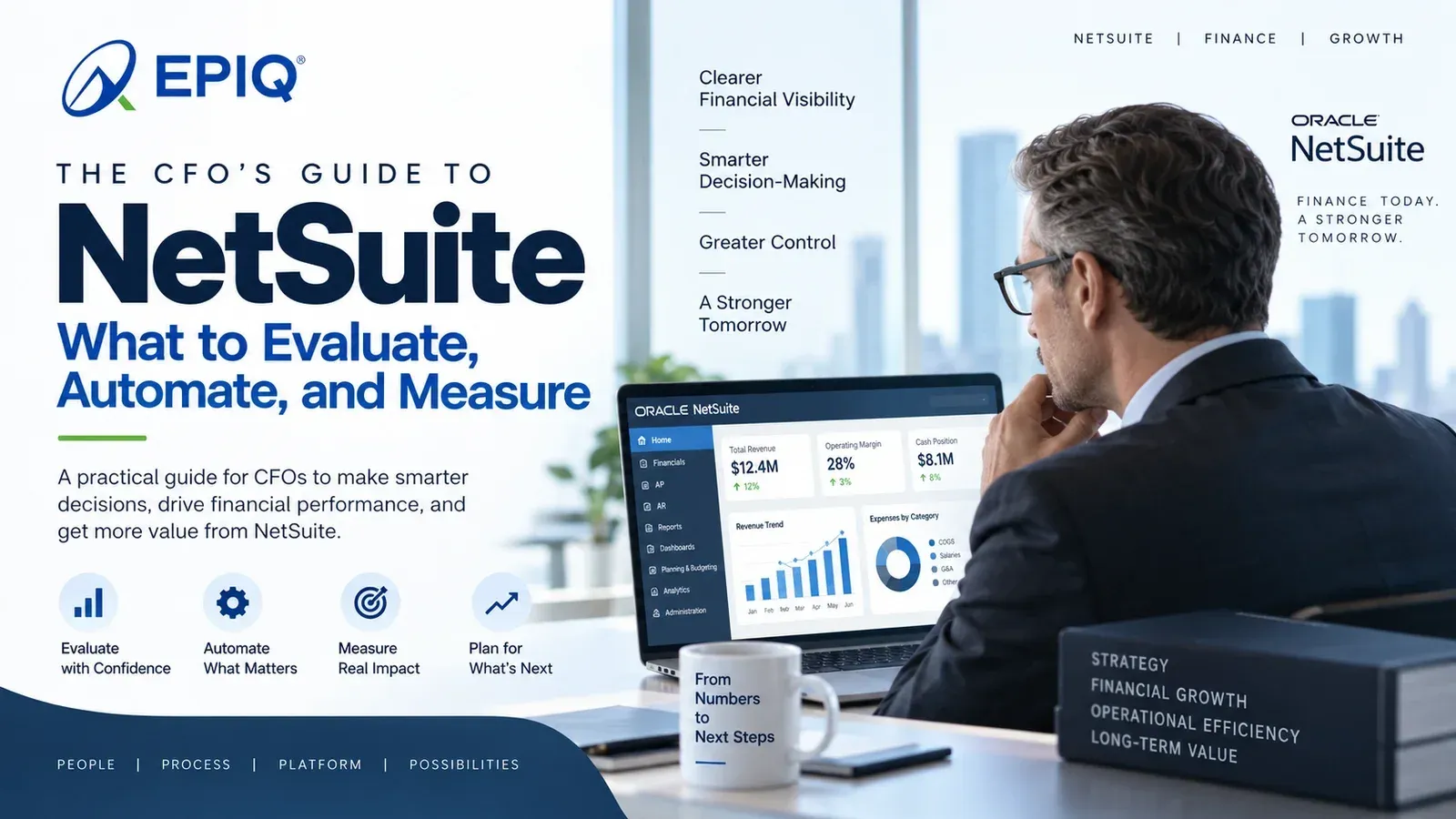
A CFO does not need another article explaining that NetSuite gives you dashboards and real-time data. You need to know what to evaluate before you commit, which finance work to automate first, and how to prove the system is paying off. This guide is built around those decisions. It gives you a practical framework to judge NetSuite against your finance priorities, a way to sequence automation, the dashboards worth building, and a before-and-after model for measuring return, whether you are evaluating NetSuite or trying to get more from the one you already run.
The five questions this guide helps you answer
- Can I trust the numbers coming out of the system?
- Can I see what is happening in the business right now?
- Can I forecast what happens next with confidence?
- Can I automate the repetitive finance work that slows my team?
- Will the system scale as the business grows and adds entities?
What does NetSuite mean for a CFO?
For a CFO, NetSuite is the financial system of record that should give you trustworthy numbers, a live view of the business, a base for forecasting, and automation for repetitive finance work, all in one place across every entity. Its value is not automatic. It depends on how it is configured, how clean your data is, how well it is integrated, and how consistently your team uses it.
Most ERP explanations start with features. A CFO should start with questions. Throughout this guide we come back to five, because they cut through the feature lists and get to what actually matters to finance:
- Can I trust the numbers? Accuracy, controls, and a clear audit trail.
- Can I see what is happening now? Real-time reporting and dashboards.
- Can I forecast what happens next? Budgeting, forecasting, and scenario planning.
- Can I automate repetitive work? Close, reconciliations, AP, AR, and reporting.
- Can the system scale? New entities, currencies, and volume without breaking.
If NetSuite answers all five well for your business, it is doing its job. Where it falls short, the gap is almost always configuration, process, or adoption, not the platform. That distinction matters, because it changes whether the fix is a new system or better use of the one you have. For a deeper look at one of these five, see our guide to real-time financial visibility with NetSuite.
Evaluation frameworkWhat should a CFO evaluate in NetSuite?
The main areas a CFO should evaluate are financial visibility, reporting, the close, cash management, FP&A, internal controls and auditability, multi-entity handling, automation, integrations, data quality, scalability, and user adoption. The goal is not to check features off a list. It is to confirm each area supports how your finance team actually needs to work.
Use the table below as a working evaluation guide. Take it into a demo, a vendor conversation, or a review of your current environment, and press for specific answers rather than yes or no.
| CFO priority | What to evaluate in NetSuite | Questions to ask |
|---|---|---|
| Financial visibility | Real-time reporting and drill-down from summary to transaction | Can I go from a KPI to the underlying transactions without exporting to a spreadsheet? |
| Financial reporting | Standard and custom financial statements, management reporting | Can we produce our board and management reports inside the system? |
| Financial close | Close checklists, reconciliations, period controls | How much of the close is tracked and managed in NetSuite versus offline? |
| Cash management | Receivables, payables, cash position, cash forecasting | Can I see a reliable cash position and a short-term cash forecast? |
| FP&A | Budgeting, forecasting, variance, scenario planning | Can we build and compare scenarios without rebuilding spreadsheets each time? |
| Internal controls | Approvals, segregation of duties, role-based access | Are approvals and duties enforced by the system, not by convention? |
| Auditability | Audit trail, change history, documentation | Can we show an auditor who changed what, and when, without manual digging? |
| Multi-entity | Subsidiaries, currencies, intercompany, consolidation | How are consolidation and eliminations handled across our entities? |
| Automation | Workflows for approvals, recurring tasks, reconciliations | Which repetitive finance tasks are automated today, and which are still manual? |
| Integrations | Connections to banking, payments, CRM, and other systems | How reliable are our integrations, and who monitors them? |
| Data quality | Duplicate records, blank fields, consistent structures | Do we trust the data enough to run reports directly, or do we clean it first? |
| Scalability | Headroom for new entities, users, volume, and complexity | What happens to this configuration when we add a subsidiary or double volume? |
| User adoption | Consistent use across the finance team | Does the team work in NetSuite, or around it in spreadsheets? |
Evaluating NetSuite, or unsure your current setup measures up?
EPIQ can walk this framework against your environment and show you exactly where it supports your finance team and where it falls short.
Request a NetSuite evaluationNetSuite capabilities CFOs should understand
Rather than list every module, here are the capability areas organized around finance outcomes, with what each one should deliver for you.
Financial management
The core ledger and transactional finance: general ledger, accounts payable, accounts receivable, revenue recognition, fixed assets, and financial reporting. This is the foundation for trusting the numbers. What to look for is a single, current ledger that every report draws from, so finance is not reconciling the system against side spreadsheets.
Financial planning and analysis
Budgeting, forecasting, scenario planning, and variance analysis. Strong FP&A means you can compare actuals to plan inside the system and model changes without rebuilding a spreadsheet each quarter. For the AI-assisted side of this, see our guide to AI in NetSuite planning and budgeting.
Cash flow management
Receivables, payables, collections, cash position, and cash forecasting. For most CFOs, cash visibility is the capability that earns its keep fastest, because a clear cash position and a short-term forecast change decisions week to week.
Financial close and consolidation
Close management, reconciliations, consolidation, eliminations, and intercompany processes. For multi-entity businesses, this is where NetSuite either saves days each month or quietly leaks them. The right setup consolidates across subsidiaries and currencies without a manual roll-up. Our guide on automating the financial close and reconciliation goes deeper.
Analytics and CFO dashboards
Executive dashboards, KPIs, and management reporting that update in real time. The test of a good CFO dashboard is not how many metrics it shows. It is whether it answers the questions you actually get asked, and lets you drill into the reason behind a number.
Finance automation
Approval workflows, recurring processes, reconciliations, and AP and AR routines. Automation is where a lean finance team gets its time back, provided the underlying process is sound first. More on that next.
Automation strategyWhich finance processes should CFOs automate first?
Automate the processes that are high-volume, repetitive, and error-prone first, because that is where automation returns the most time and cuts the most risk. In most finance teams that means accounts payable, accounts receivable, parts of the close, and recurring reporting. Fix the process before you automate it, so you are not simply speeding up something broken.
A simple rule keeps automation focused: high volume, plus repetitive, plus error-prone, equals a strong candidate. Run each process through that filter and a clear order emerges.
Accounts payable automation
Invoice capture, approval routing, purchase order matching, and vendor payments. AP is usually the fastest win because it is high-volume and rule-based, and manual entry is both slow and error-prone.
Accounts receivable automation
Invoicing, payment reminders, collections workflows, and cash application. Automating AR speeds up cash coming in and reduces the manual chase that ties up your team.
Financial close automation
Reconciliations, recurring journal entries, intercompany processes, and consolidation. The close is where automation compresses calendar days, which is often the metric leadership feels most directly.
Reporting automation
Recurring financial reports, management reporting, and variance reporting. If someone rebuilds the same report every month by hand, that is automation waiting to happen.
Expense management
Receipt capture, approval routing, and policy checks. Lower volume than AP for many businesses, but a common source of friction and policy leakage.
One caution worth repeating: automation follows process improvement, it does not replace it. Automating a broken or undocumented process just produces errors faster. Map and fix the process, then automate it.
Not sure which finance process to automate first?
EPIQ can review your close, AP, and AR cycles and sequence the automation that will free up the most time for your team, in the right order.
Talk to EPIQ about finance automationNetSuite dashboards every CFO should consider
A good dashboard is built around a decision, not a metric. For each of the dashboards below, the useful question is what it should tell you at a glance.
Executive finance dashboard
Revenue, gross margin, EBITDA, operating expenses, cash position, AR, AP, and budget versus actual. This is your single morning view. It should tell you whether the business is on plan and where to look if it is not.
Cash flow dashboard
Cash position, inflows, outflows, and short-term forecast. It should answer whether you have enough cash for what is coming, and what is moving the position.
Working capital dashboard
Receivables, payables, inventory, DSO, and DPO. It should show whether cash is trapped in operations and where.
Revenue and profitability dashboard
Revenue by segment, margin by product or business unit, and trend. It should tell you which parts of the business are actually making money.
Budget versus actual dashboard
Plan, actual, and variance by department or entity. It should surface where you are off plan early enough to act, not at quarter end.
Multi-entity dashboard
Consolidated and by-entity views across subsidiaries and currencies. It should let you see the group and drill into any one entity without a manual roll-up.
FP&AHow CFOs can use NetSuite for FP&A and forecasting
CFOs can use NetSuite for budgeting, forecasting, variance analysis, and scenario planning against live actuals, so plans stay connected to what the business is really doing. The advantage over spreadsheets is that forecasts draw from current data and can be updated without rebuilding models by hand each cycle.
The practical value shows up when you can answer leadership's real questions quickly, with numbers that tie back to the ledger:
- What happens to the bottom line if revenue falls 10 percent?
- What does a 15 percent increase in headcount do to our costs and runway?
- Which business units are driving the change in margin this quarter?
- How would a shift in customer payment timing affect our cash position?
Getting reliable answers depends less on the tool and more on the foundation beneath it: a clean chart of accounts, consistent dimensions, and trustworthy actuals. Weak data produces confident forecasts that are quietly wrong, which is worse than no forecast at all.
Return on investmentHow should a CFO measure NetSuite ROI?
A practical way to measure NetSuite ROI is to track the operational metrics it should improve, not just license cost. Measure time saved, close speed, error reduction, cash visibility, reporting effort, and how much the finance team can handle without adding headcount. Establish a baseline before a change, then compare after.
License cost versus benefit is the wrong frame on its own. The return from NetSuite shows up in finance operations: fewer manual hours, a faster close, cleaner data, less spreadsheet dependence, and a team that scales with the business instead of with headcount. The way to prove it is a simple before-and-after baseline.
| Metric | Before | After | How to measure |
|---|---|---|---|
| Month-end close duration | Baseline days | Target days | Business days from period end to close sign-off |
| Invoice processing time | Baseline | Target | Average time from invoice receipt to posting |
| Manual reconciliations | Baseline count | Target | Number of reconciliations done by hand each period |
| Reporting preparation time | Baseline hours | Target | Hours to prepare recurring management and board reports |
| Days sales outstanding (DSO) | Baseline | Target | Standard DSO calculation, tracked over time |
| Forecast preparation time | Baseline hours | Target | Hours to build and update the forecast each cycle |
| Spreadsheet dependency | Baseline count | Target | Number of critical finance spreadsheets outside the system |
| Finance automation rate | Baseline | Target | Share of key finance tasks that run without manual work |
Set your own baselines before you make a change, then remeasure after. The point is not a headline percentage. It is a small set of metrics your team agrees on and tracks honestly over time.
Want to put real numbers behind your NetSuite ROI?
EPIQ can help you baseline these finance metrics and identify where optimization would return the most, so your investment is measured, not assumed.
Book a NetSuite ROI reviewNetSuite implementation vs optimization: what should a CFO know?
Implementation is the initial setup of NetSuite for your business. Optimization is improving an environment you already run so it delivers more. Support is the ongoing help that keeps it healthy. Most established NetSuite customers do not need a reimplementation. They need optimization and dependable support.
If you are implementing, the decisions that shape everything later are your business requirements, chart of accounts, reporting requirements, integrations, data migration, internal controls, roles and permissions, automation, and room to scale. Getting these right up front is far cheaper than fixing them once you are live. Our NetSuite implementation services cover this groundwork.
If you already run NetSuite, the real question is whether you are using what you already pay for. These are the signs an environment is underused:
- Capabilities you own but never turned on.
- Manual workarounds for things the system could do.
- Too many critical spreadsheets outside NetSuite.
- Dashboards that do not answer executive questions.
- Integrations that fail or need babysitting.
- Customizations that have piled up over the years.
- Data quality problems that undermine trust in reports.
- Inconsistent adoption across the finance team.
A structured way to find these gaps is a NetSuite health check, which reviews your account against how it should be running and returns a prioritized list of what to fix.
Avoid these10 common NetSuite mistakes CFOs should avoid
Each of these is common, avoidable, and expensive if ignored. For each, here is the problem, the impact on finance, and what to do instead.
1. Treating NetSuite only as an accounting system
Impact: You pay for a business platform and use a fraction of it. Instead: use it across order-to-cash, procure-to-pay, planning, and reporting, not just the ledger.
2. Over-customizing the system
Impact: Fragile customizations that break on releases and are hard to maintain. Instead: use native features first and customize only where it earns its keep. See customization done carefully.
3. Ignoring data quality
Impact: Reports and forecasts nobody trusts. Instead: clean duplicates and enforce consistent structures, then keep them clean.
4. Living in manual spreadsheets
Impact: Wasted hours and version-control risk. Instead: move recurring spreadsheet work into NetSuite reporting and dashboards.
5. Never defining CFO dashboards
Impact: Data everywhere, answers nowhere. Instead: define the handful of dashboards that answer your real questions and build those.
6. Automating broken processes
Impact: Errors, faster. Instead: fix and document the process, then automate it.
7. Ignoring integrations
Impact: Silent sync failures and duplicate or missing records. Instead: monitor integrations actively. See why integrations fail and how to fix them.
8. Neglecting roles and permissions
Impact: Control gaps and audit findings. Instead: review roles regularly and enforce segregation of duties.
9. Failing to establish ROI metrics
Impact: No way to prove or improve the investment. Instead: baseline the finance metrics above and track them.
10. Treating go-live as the finish line
Impact: The system slowly drifts from the business. Instead: treat NetSuite as an ongoing program with regular optimization.
CFO's NetSuite evaluation checklist
A scannable checklist for both stages. Take it into your next planning or review session.
Before implementation or evaluation
- Financial reporting requirements defined
- Chart of accounts reviewed
- Multi-entity requirements documented
- Integration requirements identified
- Automation opportunities mapped
- Internal controls documented
- FP&A requirements defined
- CFO KPI and dashboard requirements defined
- Data migration requirements established
- ROI metrics established
After implementation
- Finance workflows reviewed
- Dashboards configured to real questions
- Manual processes identified
- Integrations monitored
- User permissions reviewed
- Reporting accuracy checked
- Close process measured
- Automation opportunities identified
- System and process performance reviewed
- ROI measured against baseline
When should a CFO consider NetSuite support or optimization?
Consider NetSuite support or optimization when the system is no longer keeping up with finance: the close drags, spreadsheets are multiplying, reporting needs manual consolidation, adoption is patchy, integrations fail, or the business has changed since go-live. These are signs the environment needs tuning, not that the platform is wrong.
Any one of these on its own may be minor. Several together usually mean it is time for a review:
- Month-end close still takes too long.
- The finance team relies heavily on spreadsheets.
- Reporting requires manual consolidation.
- People use NetSuite inconsistently, or work around it.
- Integrations fail or need constant attention.
- Dashboards do not answer executive questions.
- Customizations have piled up over the years.
- You have added subsidiaries, markets, or currencies.
- Finance processes have changed but the system has not.
- You are not sure you are getting enough return from NetSuite.
Depending on the pattern, the right response is ongoing NetSuite support, broader managed services, targeted optimization, or a one-time health check to find the gaps first. If you are weighing Oracle's own support tiers, our take on a NetSuite Advanced Customer Support alternative is a useful comparison.
Is your NetSuite environment keeping up with finance?
If your close drags, spreadsheets are multiplying, or you are unsure of your return, EPIQ can assess where improvements are possible and what they are worth.
Request a NetSuite health checkFrequently asked questions
Is NetSuite suitable for CFOs?
Yes. NetSuite is a finance-first ERP that gives CFOs a single ledger, real-time reporting, multi-entity consolidation, and finance automation in one system. How well it serves you depends on configuration, data quality, and adoption, not just the license.
What does NetSuite provide for CFOs?
It provides financial management, reporting and dashboards, budgeting and forecasting, cash management, close and consolidation, internal controls with an audit trail, and automation across AP, AR, and the close, across every entity and currency.
How does NetSuite help CFOs improve financial visibility?
It draws reports and dashboards from a single live ledger, so you can see current results and drill from a KPI down to the underlying transaction without exporting to spreadsheets. Accuracy depends on clean, consistent data.
How can CFOs use NetSuite for FP&A?
CFOs can budget, forecast, run variance analysis, and model scenarios against live actuals, so plans stay connected to the business. It works best on a clean chart of accounts and consistent dimensions.
What NetSuite dashboards should a CFO use?
The most useful are an executive finance dashboard, a cash flow dashboard, a working capital dashboard, a revenue and profitability dashboard, a budget versus actual dashboard, and a multi-entity dashboard. Build each around a decision, not a list of metrics.
How does NetSuite automate finance processes?
Through approval workflows, recurring processes, reconciliation tools, and AP and AR routines. Automate high-volume, repetitive, error-prone processes first, and fix the process before automating it.
How can a CFO measure NetSuite ROI?
Baseline the operational metrics NetSuite should improve, such as close duration, invoice processing time, manual reconciliations, reporting effort, DSO, and automation rate, then compare after changes. Measure operational gains, not just license cost.
What should a CFO evaluate before implementing NetSuite?
Business and reporting requirements, chart of accounts, multi-entity needs, integrations, data migration, internal controls, roles and permissions, automation opportunities, scalability, and the ROI metrics you will track.
Does NetSuite support multi-entity businesses?
Yes. NetSuite handles multiple subsidiaries and currencies with intercompany processing and consolidation, which is a core reason multi-entity businesses choose it. Consolidation quality depends on how entities and dimensions are configured.
Does a company need ongoing NetSuite support after implementation?
Most do. NetSuite updates twice a year, integrations change, and the business evolves, so ongoing support or managed services keep the environment healthy and improving rather than drifting.
What is NetSuite optimization?
Optimization is improving an existing NetSuite environment so it delivers more: cleaning data, tuning processes and dashboards, reducing manual work, fixing integrations, and turning on capabilities you already own, without a reimplementation.
What is a NetSuite health check?
A NetSuite health check is a structured review of your account against how it should be running, covering configuration, data, integrations, security, performance, and adoption, and it returns a prioritized list of what to fix.
Get more from the NetSuite you already run
If your NetSuite environment is not giving your finance team the visibility, automation, and control it needs, EPIQ Infotech can help assess where improvements are possible and plan the support or optimization to get there. Tell us where it hurts and we will show you what better looks like.
Talk to EPIQ's NetSuite team
Santosh Krishnamoorthy is a Principal ERP Consultant at EPIQ Infotech, with extensive experience in NetSuite and enterprise systems. He works with finance and operations teams to improve reporting accuracy, streamline workflows, and build ERP environments that support sustainable growth. His writing focuses on practical insights drawn from real implementation and support experience.
Free Consultation
Talk to a NetSuite Expert
Response within 1 hour