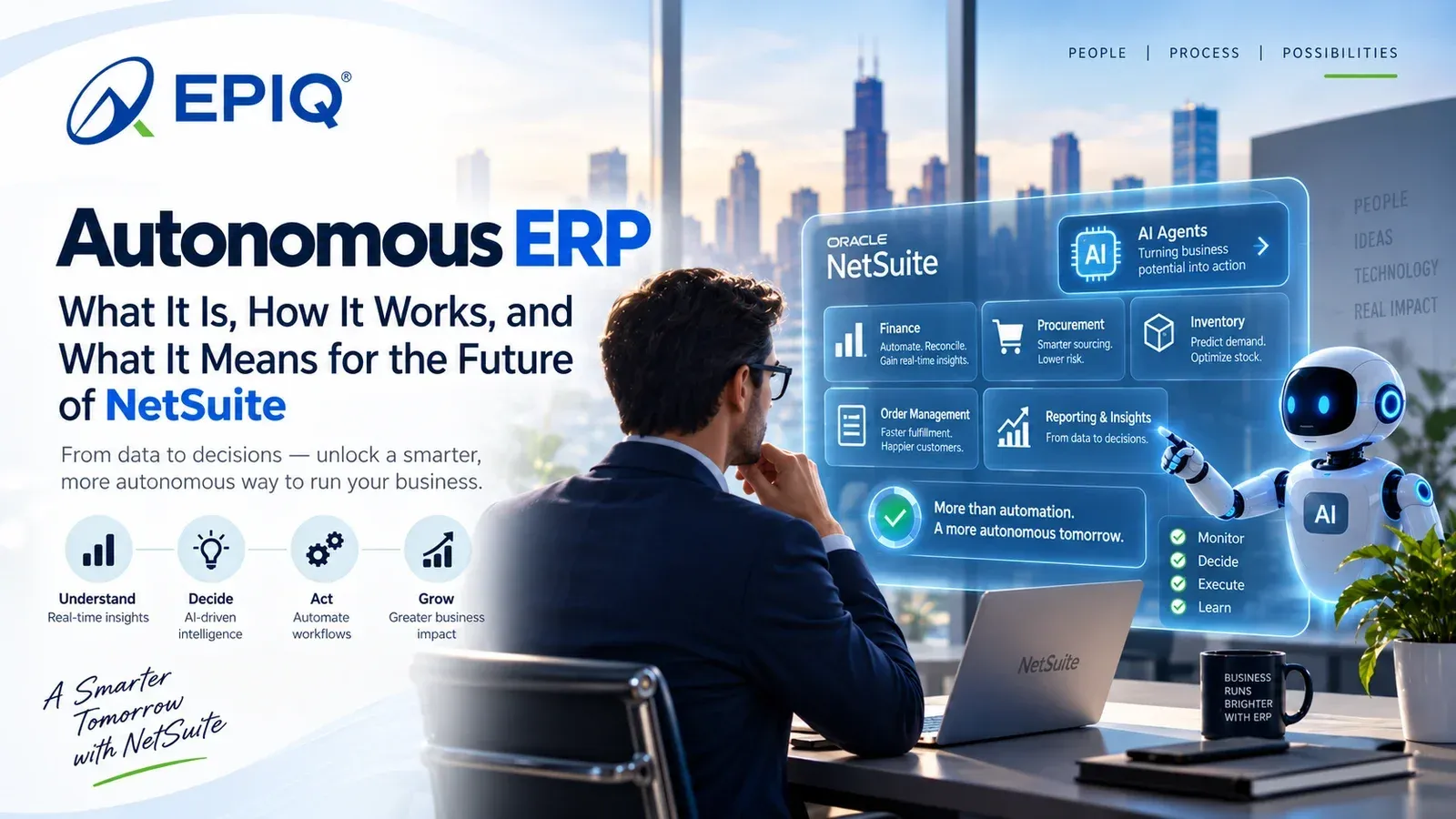
Enterprise resource planning is shifting from systems that record and report to systems that can decide and act. Here is a clear, practical look at what autonomous ERP means, how it differs from the AI features you already hear about, and where NetSuite fits.
Autonomous ERP is an enterprise resource planning system that uses AI to understand business context, make decisions within defined limits, carry out actions across connected workflows, and improve over time, all under human oversight. It moves beyond recording and automating tasks toward a system that acts on your data, not just stores it.
What Is Autonomous ERP?
Autonomous ERP is an ERP system that can understand a business situation, choose an appropriate action within rules you set, execute that action across the relevant workflow, and learn from the outcome, while keeping people in control of the decisions that matter.
The important word is bounded. Autonomous does not mean an ERP that runs your company on its own. In practice, autonomy is limited by business rules, approval thresholds, user permissions, and audit controls. The system handles the routine and the well understood, and it escalates anything unusual to a person.
This is a real shift in what an ERP is for. For most of their history, ERP systems have been systems of record: they capture transactions, enforce process, and report on what happened. Autonomous ERP adds a system of action on top of that record, so the platform can respond to conditions rather than wait for someone to notice them.
From Traditional ERP to Autonomous ERP
Autonomous ERP is not simply a new label for automation. It sits at the end of a progression, and each stage adds a distinct capability. The clearest way to see the difference is to follow one situation, low inventory, through each stage.
- Traditional ERP. Records the fact. "Inventory has fallen below the reorder threshold." A person reads the report and decides what to do.
- ERP automation. Acts on a fixed rule. "When inventory falls below threshold, create a purchase requisition." Useful, but rigid, and blind to context.
- AI-powered ERP. Predicts and recommends. "Based on demand trends and seasonality, you will likely stock out in 11 days. Reorder 400 units now." The person still approves.
- AI agents. Carry out multi-step tasks. An agent drafts the purchase order, checks it against the preferred supplier and budget, and routes it for approval.
- Autonomous ERP. Monitors demand, stock levels, supplier lead times, and your rules together, decides the right action, places the order within its authorized limit, and escalates the exceptions a human should see.
Each stage still depends on the one before it. Autonomous behavior is only trustworthy when the automation is sound, the data is clean, and the rules are explicit. Skip those foundations and you get fast mistakes instead of fast decisions.
Comparison: Four Stages of ERP Intelligence
| Capability | Traditional ERP | Automated ERP | AI-Powered ERP | Autonomous ERP |
|---|---|---|---|---|
| Decision-making | Human only | Rule triggered | AI recommends, human decides | AI decides within set limits |
| Automation | Minimal, manual entry | Fixed if-then rules | Smart suggestions on top of rules | End-to-end across steps |
| Prediction | None, historical reports | None | Forecasts and recommendations | Continuous, feeds its own actions |
| Context awareness | None | Single trigger | Pattern aware | Multiple signals at once |
| Workflow execution | Manual | Triggered task | AI assisted | Executed within authority |
| Exception handling | Manual find and fix | Stops or breaks | Flags for review | Resolves known cases, escalates the rest |
| Human intervention | Every step | Setup and exceptions | Review and approve | Oversight and escalation |
| Continuous improvement | None | Manual rule edits | Model retraining | Learns from outcomes and feedback |
Where does your NetSuite sit on this scale?
We will map your current processes against these four stages and show you the realistic next step, not a leap.
How Does Autonomous ERP Work?
An autonomous ERP works as a loop rather than a single feature. Four capabilities operate together, and human oversight wraps around all of them.
- Understand context. The system reads permitted data across finance, operations, and the supply chain, and interprets the current situation instead of reacting to one isolated trigger.
- Decide within boundaries. It selects an action, but only inside the rules, thresholds, and permissions you have defined. A payment under a set amount may proceed; a larger one waits for sign-off.
- Execute the workflow. It carries out the steps in the ERP itself: creating records, routing approvals, updating ledgers, or notifying the right people.
- Learn and improve. It compares outcomes to expectations and refines future recommendations, with your feedback shaping what it does next.
Autonomous ERP vs. AI-Powered ERP
These terms get used interchangeably, but they describe different things, and the distinction matters when you evaluate vendors.
AI-powered ERP adds intelligence to a system a person still drives. It forecasts demand, flags anomalies, drafts text, summarizes records, and recommends next steps. The human remains the one who acts.
Autonomous ERP can also take the action, within limits. The difference is not smarter suggestions; it is delegated execution. An AI-powered system tells you an invoice looks likely to go unpaid. An autonomous system can also send the reminder, apply the credit hold within policy, and update the forecast, then escalate the disputes.
Put simply: AI-powered ERP advises, autonomous ERP advises and acts. Most platforms marketed as autonomous today are a blend, with a growing set of actions the system is trusted to complete on its own.
The same logic separates autonomous ERP from traditional ERP. A traditional ERP records that something happened and waits. An autonomous ERP notices the same event, understands what it means in context, and can respond to it.
A Real Example: Accounts Receivable
Collections is a good test case, because most finance teams run it the same way and feel the same friction. Here is how one overdue-invoice situation looks at each stage.
Traditional approach
An analyst runs an aging report, spots the overdue invoices, emails customers one by one, and tracks promises to pay in a spreadsheet.
Automated approach
The system sends scheduled reminders automatically once an invoice passes its due date. Helpful, but every customer gets the same treatment regardless of history or risk.
AI-powered approach
The system predicts which invoices are likely to be paid late, scores collection risk, and recommends which accounts to prioritize and when to reach out. The analyst reviews and acts.
Autonomous approach
The system monitors payment behavior, sends reminders tuned to each account, matches incoming payments, updates the cash-flow forecast, proposes or applies dunning and credit-hold steps within policy, and escalates disputes or large write-offs to a person.
Notice what does not change: a human still owns policy, still handles judgment calls, and still reviews the exceptions. What changes is how much routine work the system carries before a person needs to step in.
Can NetSuite Become an Autonomous ERP?
NetSuite is moving in this direction, but the honest answer is that no mainstream ERP is fully autonomous today, and NetSuite is best described as an increasingly AI-native platform on a path toward greater autonomy. The useful way to think about it is in three layers: what exists now, what is emerging, and what is a future direction.
What NetSuite provides today
NetSuite already offers strong automation and a set of generally available AI capabilities, including:
- Workflow automation and approval routing through SuiteFlow, the backbone of any autonomy strategy
- Text Enhance, a generative AI feature that drafts and refines content directly on records
- Document capture tools such as Bill Capture that read and populate records
- Background machine learning for anomaly detection and payment-date prediction
- Forecasting through NetSuite EPM Advanced Predictions, plus analysis in SuiteAnalytics and NetSuite Analytics Warehouse
What is emerging
In late 2025 Oracle announced NetSuite Next, an AI-native evolution of the platform, with capabilities rolling out in phases through 2026 and beyond. According to Oracle, these features are governed by the roles, permissions, and policies customers already rely on, which is exactly the bounded model described above. Emerging capabilities include:
- Ask Oracle, a conversational interface for querying and acting on NetSuite data in plain language
- Agentic workflows that can propose or carry out tasks such as payment proposals, vendor selection, and reconciliations, with the choice to approve each action or let the agent act
- Autonomous Close and AI-based bank transaction matching, aimed at a faster, more continuous financial close
- Finance-specific agents in NetSuite EPM, such as the Planning Agent and Reconciliation Agent
These features are powerful, but many are in phased rollout and work best in well-defined processes with clear rules. Treat vendor demonstrations of full autonomy as roadmap, and pilot new agentic features in a sandbox before you depend on them.
What is a future direction
The longer-term vision Oracle has described is an ERP that runs more work in the background over time. Independent analysts generally place the most ambitious autonomous, multi-step workflows a year or more out from production readiness for most accounts. That gap is not a reason to wait; it is a reason to prepare.
Which NetSuite processes are strong candidates for more autonomy
Some areas are naturally better suited to earlier autonomy because they are rule-driven and high volume:
- Finance: accounts receivable and collections, expense processing, reconciliation workflows, cash-flow visibility, and financial anomaly detection
- Procurement: supplier selection, purchase recommendations, reordering, and exception handling
- Inventory: demand forecasting, replenishment, stock-level monitoring, and supply-chain exceptions
- Order management: order processing, exception detection, and fulfillment coordination
- Reporting and decision support: automated analysis, forecasting, executive insights, and exception alerts
Across all of them, one point holds: the value depends far more on your implementation than on the label. Clean data, standardized processes, well-defined permissions, documented approval rules, and stable integrations are what make autonomy safe. That foundation is the real project.
Find your NetSuite AI readiness gaps
We assess your data, workflows, permissions, and integrations, then show you which processes are ready for AI-driven and autonomous handling.
Will Autonomous ERP Replace Employees?
No, and the framing misses the point. Autonomous ERP is built to remove repetitive, low-judgment work, not the people who do judgment work. It handles the reminders, the matching, the routine reorders, and the first pass at exceptions, so finance and operations teams spend more time on analysis, relationships, and decisions.
The roles that grow are the ones that design the rules, review the exceptions, and govern the system. Someone has to define the boundaries the AI operates within, watch its accuracy, and adjust when the business changes. That is human work, and it becomes more important, not less, as autonomy increases.
Risks and Limitations
Any honest discussion of autonomous ERP has to cover what can go wrong. Autonomy raises the stakes because the system acts, so the cost of a bad decision is higher and faster.
- Poor data quality. An autonomous system amplifies whatever is in your ERP. Bad data produces confident, wrong actions.
- Incorrect AI decisions. Models can misread unusual situations. Boundaries and human review on higher-risk actions are essential.
- Weak governance. Without clear permissions, thresholds, and audit trails, autonomy becomes a compliance and financial risk.
- Over-automation. Automating a broken process just makes the mess faster. Fix the process first.
- Compliance and auditability. Regulated finance work needs every automated action to be logged, explainable, and reversible.
- Integration complexity and change management. Autonomy that spans systems needs stable integrations and a team that trusts and understands the tools.
This is why autonomous ERP should operate within defined limits. The goal is not maximum automation; it is the right automation, with a person accountable for the outcomes.
Is Your Business Ready for Autonomous ERP?
Readiness is less about buying new features and more about the state of your ERP foundation. Work through this checklist honestly:
- Is your ERP data reliable, consistent, and current?
- Are your core processes standardized rather than improvised?
- Are your key workflows documented?
- Are approval rules and thresholds clearly defined?
- Are your integrations stable and well maintained?
- Do you have enough reporting and visibility to spot errors quickly?
- Can your decisions be expressed as clear business rules?
- Do you have governance, permissions, and audit controls in place?
If you answered no to several of these, that is normal, and it is the right place to start. Businesses generally get far more value from strengthening the foundation first than from switching on advanced AI over shaky ground. Autonomy rewards the organizations that did the unglamorous work.
Not sure where the gaps are?
We turn this checklist into a scored assessment of your NetSuite environment, with a prioritized plan to close each gap.
How EPIQ Infotech Helps You Build Toward Autonomous ERP
EPIQ Infotech is a NetSuite consulting and implementation partner. Our role in this shift is practical: we help you build the foundation that intelligent and increasingly autonomous operations depend on, and we help you adopt NetSuite's AI capabilities in the right order.
That work usually spans NetSuite implementation and optimization, workflow automation, customization, integration, and the data-quality and governance improvements that make automation trustworthy. We also help teams read each release clearly, including the newest NetSuite AI features, so you invest in what is proven rather than what is merely announced.
As a certified Oracle NetSuite Alliance Partner since 2013, with more than 100 projects delivered, a 96 percent client retention rate, and clients across 24 countries, we bring 15 years of Oracle ERP experience to the table. We start with how your business actually runs, not with a product pitch.
See which of your processes are ready to automate
Book a no-pressure consultation. We will review your NetSuite environment, identify safe automation opportunities, and outline what to strengthen before you introduce more advanced AI.
Frequently Asked Questions
What is autonomous ERP in simple terms?
Autonomous ERP is an ERP system that can understand a business situation, decide on an action within rules you set, carry it out, and learn from the result, while people stay in control of important decisions. It goes beyond recording and automating tasks to acting on your data.
What is the difference between autonomous ERP and traditional ERP?
A traditional ERP records transactions and reports on them, then waits for a person to act. An autonomous ERP notices the same events, interprets them in context, and can respond within defined limits. Traditional ERP stores information; autonomous ERP acts on it.
What is the difference between autonomous ERP and AI-powered ERP?
AI-powered ERP adds intelligence such as forecasts, anomaly flags, and recommendations, but a person still takes the action. Autonomous ERP can also execute the action within set boundaries. In short, AI-powered ERP advises, while autonomous ERP advises and acts under human oversight.
Is NetSuite an autonomous ERP?
Not fully, and no mainstream ERP is today. NetSuite is an increasingly AI-native platform on a path toward greater autonomy. It offers strong automation and generally available AI now, and through NetSuite Next it is adding agentic workflows that can act within existing permissions, with most features rolling out in phases.
What can an autonomous ERP automate?
Good early candidates are rule-driven, high-volume processes: collections and accounts receivable, expense handling, reconciliations, reordering and replenishment, purchase recommendations, order processing, and exception alerts. Judgment-heavy work stays with people, and larger or unusual actions escalate for approval.
Will autonomous ERP replace finance and operations staff?
No. It removes repetitive, low-judgment work rather than the people who do judgment work. Roles shift toward designing rules, reviewing exceptions, and governing the system. Those responsibilities grow in importance as autonomy increases.
What are the main risks of autonomous ERP?
The biggest risks are poor data quality, incorrect AI decisions, weak governance, over-automating broken processes, and compliance gaps. Because the system acts, mistakes are faster and costlier. This is why autonomy should stay within clear rules, permissions, and audit controls.
How do we prepare NetSuite for AI-driven and autonomous workflows?
Start with the foundation: clean and consistent data, standardized and documented processes, clear approval rules, stable integrations, and solid permissions and audit controls. Then adopt proven AI features first and expand scope as accuracy and trust are demonstrated. A NetSuite partner can assess readiness and sequence the work.
Disclaimer: EPIQ Infotech is an independent Oracle NetSuite Alliance partner. This article reflects our implementation experience and publicly available information as of September 2026. AI capabilities described as emerging or future are based on Oracle announcements and are subject to change, phased availability, and regional rollout. Confirm current features, licensing, and availability with Oracle for your environment.

Santosh Krishnamoorthy is a Principal ERP Consultant at EPIQ Infotech, with extensive experience in NetSuite and enterprise systems. He works with finance and operations teams to improve reporting accuracy, streamline workflows, and build ERP environments that support sustainable growth. His writing focuses on practical insights drawn from real implementation and support experience.
Free Consultation
Talk to a NetSuite Expert
Response within 1 hour